Category Archives: energy retrofitting

Creating Electricity at Home

It may appear counter-intuitive, but getting millions of solar panels onto rooftops saves more money than it costs. Feed-in tariffs enacted by state governments have enabled ordinary Australians using their savings to build a solar power station at home benefiting the community.

Contact the appraisers at www.socalappraisalserv.com for your value questions.

When those solar households who had saved to get their panels installed under the solar feed-in tariff programs export their solar production to the grid, which occurs mostly during higher demand daytime periods, they are given a slightly higher than average retail rate for the electricity they are selling. The prices they have been paid are relatively meagre when compared with the ridiculously high rates paid to big coal or gas power plants.

At the same time that little solar households who have invested their money in a rooftop power station are being paid between 44¢ and 60¢ per kilowatt hour, the old power companies with their dirty belching coal and gas plants are receiving as much as $12.50.

Read More at: http://smh.domain.com.au/green/creating-electricity-at-home-20120118-1q5h3.html

Disclaimer: for information and entertainment purposes only.
New Windows Still Getting Window Condensation

Reprint from Holmes Magazine.

Q: Our living room’s bow-window always developed condensation and even ice on the inside pane in the winter.  My husband and I assumed it was because it was old, but even after replacing all of the windows in our 1,000 SF house, the problem is still continuing.  Our humidity level isn’t high – it’s generally around 35 percent.  What could be causing this?

A: As the season change, some homeowners might experience moisture forming on the inside of their windows.  Naturally, many think that there’s an issue with the window; but this is actually a sign that the window is doing its job to keep the warm air inside your home.  The condensation is a result of too-high humidity levels inside your home.  For example, in the winter the ideal humidity range is 20 percent  to 25 percent and , in the summer; the level should not exceed 50 percent.  Anything above these levels and condensation may occur, just as a “sweating” is the result of a glass surface that tends to have a lower temperature than most other surfaces in your home.

Ice forming on a bay or bow window can also be due to a lack of insulation under the seat board and above the head board.  Adding insulation, combined with opening your blinds and pulling back heavy curtains to let heat reach the inside pane of glass, should resolve your problem.  Also, lower your humidity and run dehumidifier to get your home into the ideal humidity range.

Disclaimer: for information and entertainment purposes only

Insulating an Old House for Energy Efficiency

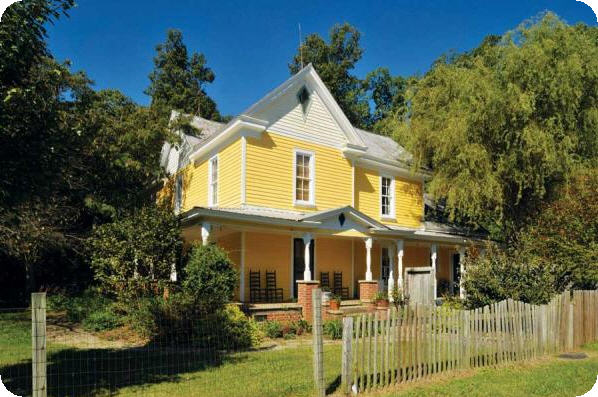
Adrienne Bashista’s historic 1915 farmhouse needed many energy-efficiency upgrades to make it through the cold North Carolina winter. To make the home more efficient, Bashista and her husband got a home energy audit, added insulation to the attic and under the floor, and caulked all cracks they could find in their old farmhouse.
In the early 2000s, my husband and I started a business renovating historic properties in central North Carolina. These homes were beautiful, fascinating, full of history—and filled with leaks. They weren’t built to be heated and cooled with central heat and air-conditioning. We dedicated ourselves to finding ways to remain true to these houses’ beautiful historical nature while also providing modern conveniences. Today, our company focuses on renovating historic homes by making them more livable and energy-efficient. By insulating an old house, we preserve its beauty and historical significance as well as its energy costs.

Read more: http://www.naturalhomeandgarden.com/energy-efficiency/insulating-an-old-house-zmhz12jfzmel.aspx?page=1#ixzz1hqtBPSbc

Disclaimer: for information and entertainment only