Category Archives: energy retrofitting

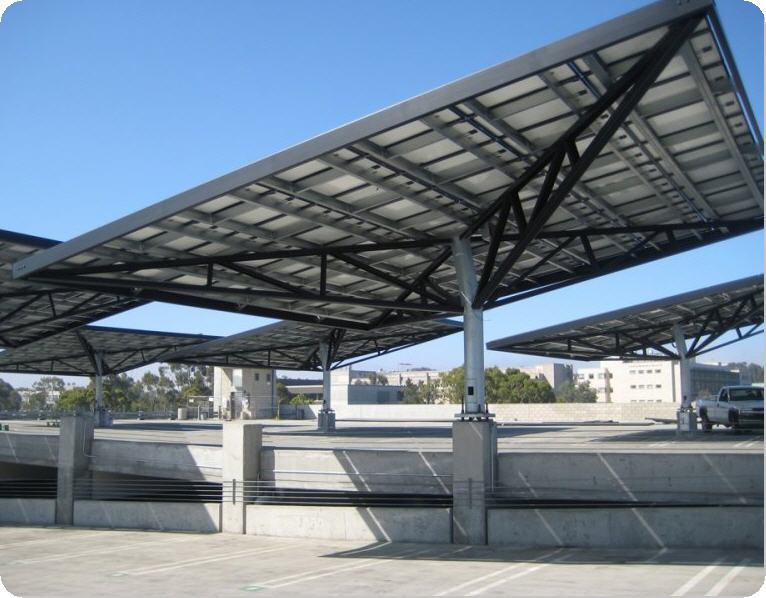
What is a Solar Tree?

Much like natural trees, the solar trees provide shelter from the rain, and shade the path on scorching hot days. While silently generating renewable juice the trees add a clever design twist to an often neglected area – the parking lot. Compared to roof mounted photovoltaic systems, solar trees are considerably easier to install – especially if your architecture is more intricate than a square box with a flat roof (the ideal condition for installation). Planting solar trees in the parking lots helped surmount some of the installation challenges.  An elegant solution to a tricky problem.
Will this happen in residential? 

Envision Solar, a company developing and building solar groves (for Kyocera among others) is also planning to enter the residential market next year. Solar trees designed for smaller buildings and homes are in the works. Do-it-yourself kits would easily allow two- and four-car solar carports to be transformed into home photovoltaic systems.

Will this add value to your home?  The short answer is probably yes but you need an appraiser that is qualified in green properties and energy retrofits to determine value.  You can contact the “Green” appraisers at www.socalappraisalserv.com to answer your value questions. 

Read more about solar trees at: http://green.blogs.nytimes.com/2010/07/14/will-solar-trees-sprout-in-parking-lots/

Congratulations to Envision Solar; they are reporting its first quarterly profit, just over a year going public.  Read more at: http://www.signonsandiego.com/news/2011/aug/17/solar-tree-maker-posts-quarterly-profit/

Disclaimer: For Information and Entertainment Purposes only


What is a LEED Certified Home?

What is LEED?

LEED, or Leadership in Energy and Environmental Design, is an internationally recognized green building certification system. Developed by the U.S. Green Building Council (USGBC) in March 2000, LEED provides building owners and operators with a framework for identifying and implementing practical and measurable green building design, construction, operations and maintenance solutions.

Why LEED? – There are financial incentives.  There are tax credits and abatements, fee reductions or waivers, grants, and other incentives.  Read more about the incentives at http://www.usgbc.org/DisplayPage.aspx?CMSPageID=2078#market

Does LEED cover homes?  I have seen information for commercial properties but not much on homes.  A LEED-certified home is designed and constructed in accordance with the rigorous guidelines of the LEED for Homes green building certification program. LEED for Homes is a consensus-developed, third party-verified, voluntary rating system which promotes the design and construction of high-performance green homes. 

Watch a video on the benefits of a LEED home: http://vimeo.com/14613747

Can an existing home be renovated to get LEED certified?

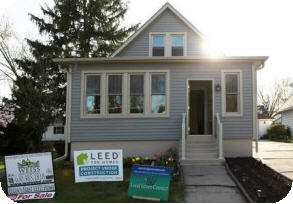
AFTER LEED

Existing buildings of the commercial type are included in LEED BD+C, the core LEED standard, since it’s a fact that so much work has to be done to an existing building that virtually it is like constructing a new one.

So the same approach would be true of LEED for Homes – you would have to do major envelope overhaul with new windows etc.

To verify the quality of insulation for example you would have to open up the walls and install not only new insulation but an infiltration barrier too. You might find a local provider – unlike commercial LEED, Homes have to have a supervising third party – who would work with you and do the tests to try to get the house certified.

However, you have other alternatives, (i.e. you do not have to pursue LEED). With the Building Performance Institute (BPI) or HERS/Resnet inspections and rating systems, you can arrive at a more or less verifiable energy-saving profile that will give you quantifiable results.

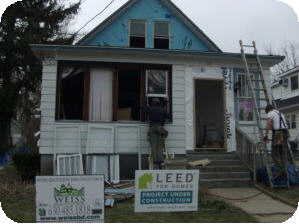
You can read all about a foreclosed home that turned into a LEED platinum Home at: http://www.leedforhomesillinois.org/single-family/builder-takes-foreclosed-home-to-leed-platinum-905

BEFORE LEED


If I have a LEED certified Home how will that effect value?

Since there are not a lot of LEED homes to use as comparables this can be a difficult assignment for an appraiser that is not experienced with appraising green properties.  The appraisers at www.socalappraisalserv.com are qualified to appraise green properties and are working with professors at UCSD and Calcerts to develop new valuation techniques  to meet the growing green property trend.  If you have any questions contact an appraiser at www.socalappraisalserv.com

disclaimer: for Information and Entertainment Purposes Only

What is a HERS Rating?

A Whole-House Home Energy Rating is a comprehensive evaluation of the efficiency of the entire home. The homeowner receives a written report that includes a numeric score or “rating” of the home, plus recommendations for improvements that will reduce energy bills and make the home more comfortable. Knowing the energy rating of your home is similar to knowing the miles per gallon rating of your car.

What kind of tests will they do in your home?:

  1. Test and seal air leaks in the “building envelope.” They will do what is called a blower door test  and the pressure test will show where the air is leaking out so you can “plug” the leaks and make your home less drafty.  You want to keep heat and AC inside your home.    Leaks let that conditioned air escape resulting in higher energy bills.
  2. Inspect attic insulation to make sure you have properly installed insulation and possibly increase attic insulation to R-3.
  3. Test and seal air ducts.
  4. Tune-up the heating and cooling system.
  5. Appliance tests.

Read more about HERS rating at: http://www.energy.ca.gov/2009publications/CEC-400-2009-008/CEC-400-2009-008-BR-REV1.PDF

Will this add value  to your home?  Depends.  If you have a HERS rating that can be presented to the appraiser that is one tool for the appraiser to determine value for your property being energy-efficient.  The appraisers at Southern California Appraisal Services have been working with UCSD’s Environmental Engineering Department on ways to use a HERS rating to determine value of a property’s energy efficiency.  If you have questions regarding value contact the appraisers at www.socalappraisalserv.com

Disclaimer:  For Information and Entertainment Purposes.