
Category Archives: energy savings

Is a Home Windmill A Good Choice for You?

windmill

So maybe you’re thinking you want to generate your own electricity, and home wind power has crossed your mind. After all, who really enjoys paying a utility bill? Small wind energy is renewable, non-polluting, and, in the right circumstances, can save you money.

Will a windmill add value to your property?  Contact the appraisers at www.scappraisals.com  for your value questions.

But is home wind power a good choice for you? The answer may surprise you, because living in a windy area is not necessarily the most important factor. In fact, many properties are not a good fit for installing a wind turbine even if they have a lot of wind (for reasons we’ll get into). On the other hand, if you want to go off-grid and produce your own electricity, you almost certainly want to consider installing a home wind turbine, even if your location is not notably windy.

Off-Grid Residential Wind Power

Here’s the deal: For a home wind turbine to be worth your investment, you really need to live on an acre or more. That’s the guideline from the U.S. Department of Energy’s Guide to Small Wind Electric Systems, a free publication for homeowners. Living in a rural area helps, because if you’re in a residential neighborhood, you’re likely to run into conflicts with zoning and local homeowners associations. Additionally, you’re more likely to find a high average wind speed in wide open spaces far from windbreaks such as buildings and trees. Altogether, while installing a small wind turbine in a city or suburb is certainly possible, you’re much more likely to have the right conditions for home wind power if you live well outside city limits.

Read more: http://www.motherearthnews.com/renewable-energy/home-wind-power-zm0z13amzrob.aspx#ixzz2Q54wvlt2

Disclaimer: for information and entertainment purposes only
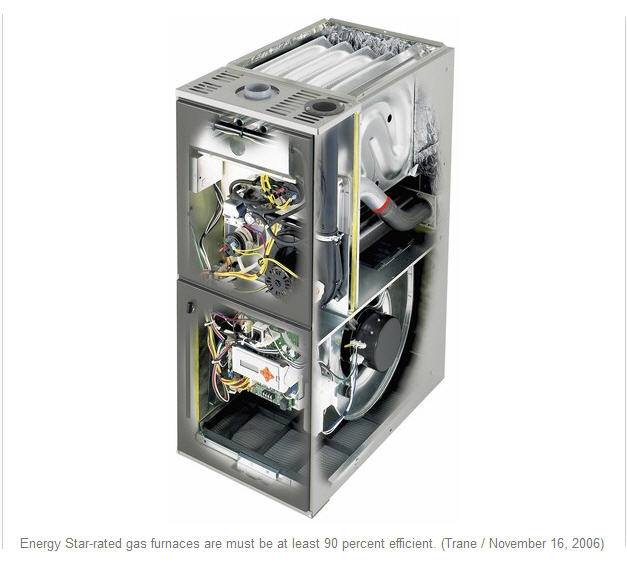
How to Compare Furnance Efficiency When Buying

furnace

Like most fuel-saving home appliances, high-efficiency furnaces cost more than others upfront. That complicates the idea of upgrading. Does it make sense to invest in a new system when you already have one that works?

Start answering those questions by zeroing in on three key points. As the heating season ends, the time is right to re-evaluate. A contractor can test the existing unit and provide an efficiency rating that you can check against new models. And there’s a season’s worth of fuel bills to compare with projected operating costs of possible replacements.

The idea is to establish where your system is now and what you can save by going to the range of 95 percent efficiency where only 5 cents of every heating dollar is lost in exhaust. (There is no exhaust with electric systems on site. There is a loss where the power is produced, say, in a coal-fired generating plant.)

Compare AFUE ratings

The Annual Fuel Utilization Efficiency, printed on the manufacturer’s nameplate and product literature, expresses the percentage of usable heat derived from the fuel. If you’re old furnace says 75 percent and the new one says 95 percent, you’ll save about 20 percent of the fuel bill. Except those are optimum ratings. You’ll get the number on a new furnace, for a few years at least. But after several years efficiency drops a few points from age, and 5 to 10 percent without regular maintenance. The AFUE is also shown on the big yellow EnergyGuide label, which is different on furnaces than on most other major appliances. Instead of estimating operating costs, it shows the AFUE rating as a percentage on a sliding scale between the least and most efficient models in the category. To carry the Department of Energy’s Energy Star label, gas furnaces must have AFUE rating of at least 90 percent, and oil furnaces at least 85 percent.

Read more at: http://www.chicagotribune.com/classified/realestate/home/sc-home-diy-furnace-upgrade-20130322,0,359812.story

Disclaimer: for information and entertainment purposes only

An Apartment Building with No Parking – A Green Space On Every Level

apartment

The 44-unit apartment building with ground-floor storefronts, proposed for Boston’s Allston neighborhood, is a fairly bold and modern design under development by the studio of Sebastian Mariscal, the architect. But the most radical thing about it is what is missing — parking.

Does parking effect value?  Contact the appraisers at www.scappraisals.com for your value questions.

The building, which would be completed in late 2014 if the necessary permits were obtained, sits on an 18,000-square-foot lot currently occupied by — as it happens — a parking lot and a used-car dealer. “If we do the building the traditional way, the entire footprint would be devoted to parking,” said Mauricio De la Peña, the managing director of the Sebastian Mariscal Studio and the project manager for the Allston building. “We’re trying to avoid that by creating green space on every level.”

Plans include a 4,000-square-foot community garden and social area accessible to residents on the roof, and bicycle racks on the lowest level. There will be six spaces for the car-sharing vehicles that are popular in Boston.

Who will live in the building? Mr. De la Peña said in an interview that Boston “like New York, has many residents who don’t own a car and rely on public transportation.” The proposed building is close to the Green Line of the Massachusetts Bay Transportation Authority and also to a proposed commuter rail station, he said.

An apartment building without parking is a challenge, because city regulations overseen by the Boston Redevelopment Authority specify the number of parking spaces per dwelling unit. “We’re working with the authorities and the community,” Mr. De la Peña said. “We need to get the concept approved.”

Read More at: http://wheels.blogs.nytimes.com/2013/03/04/a-boston-building-for-people-not-cars/?ref=realestate

Disclaimer: for information and entertainment purposes only