
Category Archives: energy savings

Do Your Ducts Need Work?

duct

Although many homeowners consider duct cleaning a way to make their indoor air cleaner, research on whether it can really create a healthier home is in the early stages.

The Environmental Protection Agency recommends looking into duct cleaning after fires, floods, pest infestations and in hazardous waste situations, or if you can see particles coming out of your ducts. Otherwise, the agency says it’s not necessary for the average household.

Does poor duct work effect value?  Contact the appraisers at www.scappraisals.com for your value questions.

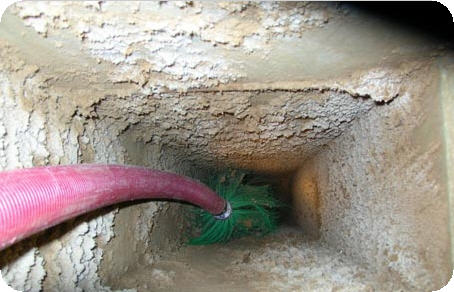
Tom Keys, president of Atlantic Duct Cleaning in Sterling, Va., says his company has done more than 80,000 duct-cleaning jobs, and that many customers report back that they have better air quality, a cleaner home and lower energy costs. Customers often are surprised at how much debris collected in their ductwork over the years, he says.

“Most of the people who do it, do it for peace of mind,” Keys says. His company has found all sorts of items in ductwork beyond dirt and grime, including class rings, rare baseball cards and construction debris from when the home was built.

Keys encourages homeowners to ask duct-cleaning technicians for evidence that there is dirt in the ducts that should be removed.

Jodi Araujo, executive director of the National Air Duct Cleaners Association, says homeowners can tell when ducts are dirty by simply removing a register cover, inserting a camera and clicking a photo.

On the other hand, John DeSilvia, a contractor and host of DIY Network’s “Rescue My Renovation,” doesn’t generally recommend duct cleaning to homeowners. It’s normal for dirt to accumulate and stick to the sides of air ducts, he says. The exception, he says, is if there’s visible mold growth.

If you do have ductwork cleaned, he advises getting a few estimates and ensuring that the service you hire uses high-powered equipment to capture what they dislodge. Otherwise, the effort could backfire.

“Any dust and dirt not collected will be distributed throughout your home, causing a bigger problem,” DeSilvia says.

If you decide to get your home’s ductwork cleaned, expect to pay between $400 and $800 if there’s one HVAC (heating, ventilation and air conditioning) system. If you have more than one zone, you could pay more. That’s because duct cleaners don’t just clean the ducts; they also clean the furnace and air handler for each unit, which could extend the life of your appliances.

In addition, they can identify any places where a duct has become unsealed, torn or flattened, preventing good airflow. Many professional duct cleaners recommend having a system cleaned every five to eight years.

Read more at: www.utsandiego.com/news/2013/mar/02/tp-do-your-ducts-need-work/?print&page=all

Disclaimer: for information and entertainment purposes only
Use a HERS Score When Shopping for A Home; Compare Energy Use

hers

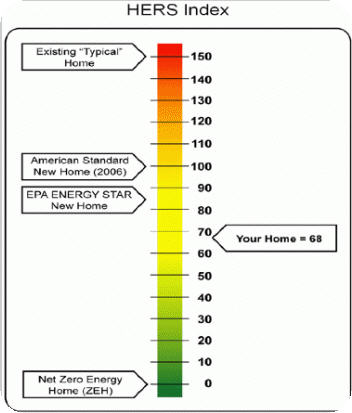
What: The Home Energy Rating System is a score for energy use that is designed to make it easier for consumers to compare homes. It’s often compared to the EPA fuel-efficiency stickers seen at new car dealerships — only for houses.

How does it work: The lower the index score, the more energy-efficient a home is. A new home that conforms to minimum current efficiency standards typically scores 100. By comparison, a home with a score of 70 should consume only 70 percent as much energy.

Can a low HERS score add value to your home?  Contact the appraisers at www.scappraisals.com for your value questions.  Southern California Appraisal Services is the West’s forerunner in green and energy-efficient property appraisals.

Who uses it: The score is recognized by the Department of Energy and the Environmental Protection Agency, and it is gaining influence among homebuilders and mortgage lenders. The Oceanside-based nonprofit Residential Energy Services Network oversees the training of independent contractors to rate homes fairly and consistently. RESNET also helps foster market demand for home energy ratings.

Q: When does the energy score come into play?

A: One of the things we’re asking of consumers is to know your score when you’re shopping for a home, so that you can tell the relative efficiency from one home to the other. Why is this important? Government-sponsored mortgage lender Fannie Mae has found that the cost of heating, cooling and hot water for a home is the highest cost of homeownership outside the mortgage loan.

Read entire article at: http://www.utsandiego.com/news/2013/mar/01/tp-keeping-score-with-energy/?page=1

Disclaimer:  for information and entertainment purposes only

Might Want to Reconsider an Electric Vehicle; CA to Pay More for Gas with Increased Excise Tax

Californians are conserving fuel and being penalized for it!!!!  We are going to be made to make up budget shortfall for conserving!!!

ec

As if we don’t already pay enough for gas in California, come this summer we may be taxed on it even more by the state.

The tax Californians pay for each gallon of gas they buy — called the excise tax — is expected to increase 3.5 cents per gallon in July to 39.5 cents per gallon.

The state Board of Equalization — charged with setting the rate since 2010 — will meet Tuesday in Culver City to consider about a 10 percent increase because previous tax collections fell short of budgeted amounts. The excise tax isn’t the only one we pay at the pump. The state also charges 2.25 percent in sales tax, and the federal government charges 18.4 cents per gallon in excise tax.

So how much more will you pay? If you’re like most Americans, you drive an average of 15,000 miles per year. And if you figure you get 20 miles per gallon, that means you’d buy 750 gallons of gasoline. Under the current system, with the average gallon of gas in California costing $4.217, over the year you would buy $3,162 in gas, including $408 in federal and state excise taxes, and about $70 in state sales tax.

That doesn’t include local taxes, like the half-cent San Diego charges. If the California Board of Equalization approves the rate increase, the extra tax would kick in an additional $26.25 over the year.

California’s gas prices are routinely among the highest in the nation, and so is its gas tax.

In a ranking of states released last month, the American Petroleum Institute showed California trailing only New York in combined excise, state and local taxes. Should California’s 3.5 cent increase go through, however, the Golden State would be the most expensive.

The increase would be the second state tax hike Californians would see this year after the passage of Proposition 30, which raised the sales tax a quarter percent. The jump would affect only those who buy regular gasoline.

Those who buy diesel will see a 1.94 percent increase in their sales tax in July, but the excise tax rate — 10 cents — is not expected to increase, a Board of Equalization memorandum says.

The 3.5 cent increase would be the largest since the state Legislature switched the gas-taxation system in 2010, when it lowered the sales tax to 2.25 percent from 8.25 percent. At the same time, it roughly doubled the excise tax to 35.3 cents per gallon.

Read more at: http://www.utsandiego.com/news/2013/feb/24/tp-expect-even-higher-prices-at-the-pump/?print&page=all

Disclaimer: for information and entertainment purposes only