
Category Archives: energy savings

Use Your Graywater to Water Your Yard

How it works

Graywater systems channel household water from showers and washing machines to yards, gardens and orchards, through diverted plumbing lines.

There are limits to the reuse: kitchen water from the sink or dishwasher can’t be graylined because food waste could contain bacterial contaminants. Water containing human waste from toilets or diapers also has to go to sewers.

And while the water can safely irrigate fruit trees, tomato vines or berry bushes, it can’t go directly on root crops, or on low-lying plants such as lettuce.

Still, advocates say that in San Diego, where about half of household water goes to irrigation, graywater can make a dent in water use.

“San Diegans use about 50 percent of their water outside,” Lightner said. “For single-family households, if you could save your water, it would definitely reduce your water bill, and reduce consumption throughout the city.”

Until now, complex permit requirements have led many conservationists to install the systems informally.

“It’s sort of one of those things that has happened forever,” said Laura Allen, co-founder of Greywater Action, a Bay Area-based organization that has promoted graylines since 1999. “They weren’t very common in urban areas, but in rural areas, they were always common.”

The changes the city is considering could make graywater systems more common in parched, populous San Diego.

Read more at: http://www.utsandiego.com/news/2012/oct/29/tp-from-graywater-to-green-landscapes/?page=1

Disclaimer: for information and entertainment purposes only
Button Up Your Home This Winter

Before long we’ll be complaining about the cooler weather and the high cost of energy bills.

But you can change the script this year by winterizing your home. It need not be a massive undertaking. Small steps can often add up to significant savings and prevent problems in the future.

In Midland, Mich., for example, the Dow Chemical Co. teamed up with local contractors on the Revitalize Home. The 1960s ranch-style house got air-sealing and insulation upgrades last winter, and is expected to show a 30 percent energy savings this winter. And that’s without major improvements such as window replacements or HVAC upgrades.

Keep the cold air out, and winter won’t seem so bitter.

“The average home has half a mile in gaps and cracks,” says Kaethe Schuster, remodeling market manager for Dow Building Solutions. “That’s equivalent to a 4-by-4 window left open. So I don’t think people are aware of the impact (of drafts). Twenty-five to 40 percent of energy loss is because of those gaps.”

There are a variety of effective measures to winterize a home, some extensive and best left to the pros, but many others of the do-it-yourself variety. Run down the list and save yourself money — and keep warm and cozy in the bargain.

Read More at: http://www.chicagotribune.com/classified/realestate/home/sc-cons-1011-winterize-home-20121011,0,3829662.story

Disclaimer: for information and entertainment purposes only

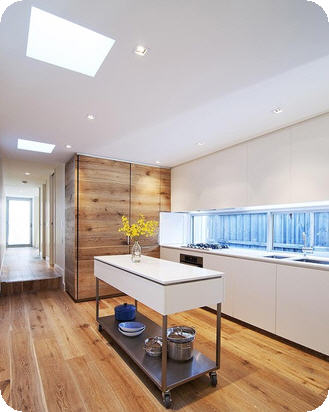
How to Lighten Up a Dark Home

The narrow terraces that characterize older areas of inner Melbourne bring with them a bunch of problems when it comes to extending the living amenity.

The single-level ”tunnel houses”, especially those just five meters wide, such as the 1880s St Kilda property architect Tony Vella was engaged to change, are often compromised for natural light and have unwieldy internal arrangements.

In the 1980s, the house had been extended towards the north and had a long footprint incorporating a small side courtyard as user-unfriendly as the tiny backyard and ”the dark, central living room and kitchen”. In a commission to modernise to give the house three good-scale bedrooms, two bathrooms and a living-dining-kitchen, Vella was given an extra hurdle. With a pending addition to the family, it needed to happen in a hurry.

How to accelerate a rebuild that Vella said came down in essence to an interior-design project on a tight budget and in a precinct with heritage overlays, when the town-planning processes ”can often become difficult and lead to lengthy delays, and when a big part of the brief was to minimise delay”?

Advertisement

Solution: build within the existing house fabric. Vella says the ’80s brick additions were ”solid and well built. So we held on to the existing fabric and kept the window openings in the same positions.” The strategy sped through planning within three months. ”We spent another three months on the documentation and made the decisions quickly. We took another three months in the construction.

Read more at: http://smh.domain.com.au/renovation-and-decoration/light-at-the-end-of-tunnel-vision-20121012-27ge9.html

Disclaimer: for information and entertainment purposes only