
Category Archives: energy savings

San Diego – Utilities Smart Meters Optional

State regulators are allowing San Diego-area utility customers to opt out of wireless “smart meters” that relay detailed information about home electricity use by radio frequency to the local power company.

San Diego Gas & Electric residential customers who do not want a wireless meter, for whatever reason, can choose to have an analog electric meter or gas meter or both, under provisions approved Thursday by the California Public Utilities Commission.

Opt-out customers will be assessed an initial fee of $75 and a monthly charge of $10 thereafter. Low-income and other customers enrolled in the California Alternate Rates for Energy program pay a $10 fee and a monthly charge of $5.

The charges and fees do not come close to covering the expense of maintaining analog equipment inventories, and they could be increased during upcoming proceedings about implementation costs.

SDG&E has installed more than 1.3 million smart meters for the vast majority of its customers, an effort that began in 2008.

The utility’s network of wireless equipment does away with meter readers and holds out the promise of helping people better understand how they are using electricity — and eventually how they might save power and money.

A small fraction of customers have health concerns about the effects of adding yet more wireless signals to the modern home. Some customers also oppose sharing information about their hourly energy use with the utility, or suspect they might be penalized by conservation incentives.

Customers who were placed on a smart-meter delay list while the opt-out plan was being crafted will still get a wireless meter unless they elect to participate in SDG&E’s opt-out program, the utilities commission said on Thursday.

Read more:http://www.utsandiego.com/news/2012/apr/20/tp-utilitys-smart-meters-optional/?print&page=all

Disclaimer: for information and entertainment purposes only
Control Air Movement – Save Energy

The control of air movement—the reduction of uncontrolled air leakage and the inclusion of controllable ventilation—is essential to minimise the need for supplementary heating and cooling. This can save up to 20% on heating and cooling costs and improve comfort.

Contact the appraisers at www.scappraisals.com for questions about savings equaling increase in value.

Air leakage has a significant impact on thermal performance. This should be minimised by draught proofing new and existing homes. This can prevent heat loss in winter, thereby saving on the cost of heating, and prevent the entry of warm air in summer, reducing the need for cooling.

A typical home with a wall vent in each room will have approximately one air change per hour (one air change per hour occurs when the volume of inside air is replaced totally by outside air in a period of an hour). Sealing the vents reduces the air change rate to 0.5 per hour, which reduces overall energy requirements by up to 15% and still allows for adequate ventilation.

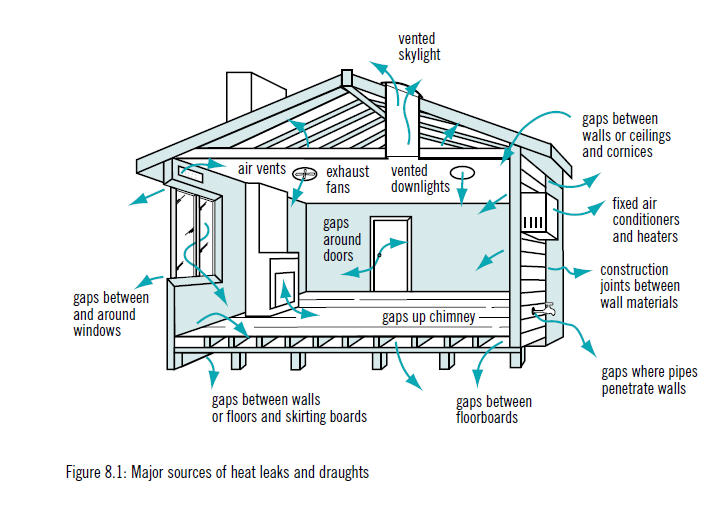
Many older homes have significant air leakage, which can average up to three air changes per hour. Some typical sources of air leakage are shown in figure 8.1. Limiting air leakage in older homes can save up to 25% of heating energy costs.

Ventilation should be planned to cool the home and its occupants in summer, and reduce or eliminate the need for mechanical air conditioning.

Read more at: http://www.sustainability.vic.gov.au/resources/documents/ESHousingManualCh08.pdf

Disclaimer: for information and entertainment purposes only

Cool Your Home Naturally – Harnessing Cooling Breezes

Any air movement across the skin creates a cooling effect through increased evaporation. This works in high humidity areas, as long as the temperature is below 40°C (104 degrees F). Townsville is a high humidity area with average summer temperatures in the low thirties. This makes it a perfect region to utilise prevailing breezes for maximum cooling benefits.

You can harness breezes by:

1. Maximising access to breezes;

2. Enabling ventilation by convection; and

3. Creating air movement.

Read more at: http://www.townsville.qld.gov.au/resident/planning/sustainable/Documents/Sustainable%20Housing%20Guide%202.pdf

Disclaimer: for information and entertainment purposes only