
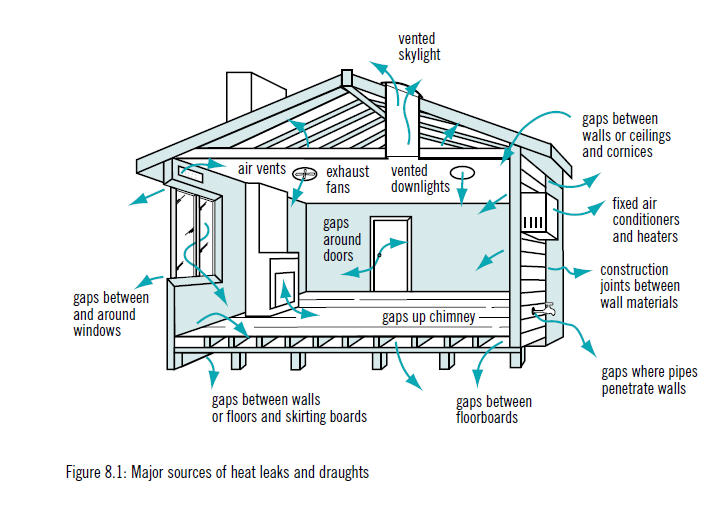
The control of air movement—the reduction of uncontrolled air leakage and the inclusion of controllable ventilation—is essential to minimise the need for supplementary heating and cooling. This can save up to 20% on heating and cooling costs and improve comfort.
Contact the appraisers at www.scappraisals.com for questions about savings equaling increase in value.
Air leakage has a significant impact on thermal performance. This should be minimised by draught proofing new and existing homes. This can prevent heat loss in winter, thereby saving on the cost of heating, and prevent the entry of warm air in summer, reducing the need for cooling.
A typical home with a wall vent in each room will have approximately one air change per hour (one air change per hour occurs when the volume of inside air is replaced totally by outside air in a period of an hour). Sealing the vents reduces the air change rate to 0.5 per hour, which reduces overall energy requirements by up to 15% and still allows for adequate ventilation.
Many older homes have significant air leakage, which can average up to three air changes per hour. Some typical sources of air leakage are shown in figure 8.1. Limiting air leakage in older homes can save up to 25% of heating energy costs.
Ventilation should be planned to cool the home and its occupants in summer, and reduce or eliminate the need for mechanical air conditioning.
Read more at: http://www.sustainability.vic.gov.au/resources/documents/ESHousingManualCh08.pdf
Disclaimer: for information and entertainment purposes only


 Green Real Estate Appraiser