
Tag Archives: attic

How to Baffle Heat Producing Fixtures

baffle

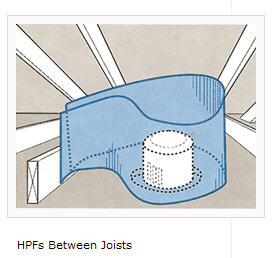
Some electrical devices located in attics, generate lots of heat when operating. If you pile insulation on top of a heat producing fixture (HPF), it could get hot enough to start a fire. Before blowing insulation into an attic, place baffles around all HPFs.

Heat producing fixtures include most recessed lights and heaters, doorbell transformers, electrical wiring connections not in junction boxes, metal flues and knob & tube wiring. Heaters with an Underwriter’s Laboratory label that says “Heater” or “Air Heater” don’t need to be baffled. The same is true of newer recessed lights that are rated “IC,” which means they can be covered with insulation. They must have an identifying label. The label could also be on the outside of the housing, visible from the attic. If it’s inside the housing, you’ll have to remove the light bulb and maybe the trim piece that fits inside the housing to find the label. If you don’t see any of these labels, then you must baffle the fixture.


Baffles should be made from a solid, flame resistant material. Wide metal flashing makes a great baffle (except for use around wiring). It’s easy to bend, can be fastened with staples, and cuts easily with a utility knife.  In some areas, fiberglass insulation batts can be used as baffles. Treated cardboard, sometimes used to baffle attic vents, is not acceptable for baffling HPFs. Baffles must be be firmly attached to something in the ceiling structure, such as the ceiling joists, rafters, or roof sheathing.

Read more at: http://oikos.com/library/weatherization/hpfs/hpfs.html

Will increasing insulation in my home increase value?

First it needs to be determined if you need to increase your insulation to lower your energy bills or is there other problems like not property installed windows or deferred maintenance issues.  High energy bills and drafts are a good indicators that things are not as airtight as they should be.  An energy analyst can be hired to do a whole house audit to determine where you are loosing energy.

If your home was built before 1975 the insulation probably functions as a t-shirt rather than a parka; pre 1950 houses tend to lack insulation altogether.  Even if your home is brand new builder’s grade materials often do not meet the highest standard. 

Top most overlooked problem areas to troubleshoot:

  1. Attic – Up to 50% of the house’s energy is lost through the roof.  Have your roof brought up to at least and R-value of 50.  Factors will depend on the climate in your  area. 
  2. The walls surrounding your home – If your home lacks insulation in the wall cavities a professional will make small penetrations (about 2 inches) from the outside and insert a long tube to inject cellulose fiber insulation.  This is called dense packing and with sealing exterior leaks, helps eliminate random hot and cold spots.
  3. Around windows – removing the trim and packing the void with insulation will make a huge difference.
  4. Crawlspace – This insulation job can be the most expensive and must be done to strict code requirements. 
  5. Foundation – Fill gaps around the perimeter of the house frame, to which the floor joists are attached.

Insulation Index:

Closed-cell polyurethane spray foam (purple or blue) – it is double the R-value of other blown in options at 6 per square inch of thickness.  Some spray foams can act as their own vapor barrier but check with the manufacturer.  Once installed should be covered with 1/2 inch thick drywall or another fire-rated material.

EPS foam board (Pink) – it is pink like fiberglass batts but this rigid foam board has a higher R-value of 5 per square inch.  It serves as its own vapor barrier and creates a thermal break.

Mineral wool batts (green) – has an R-value of 2.3 to 3.97 per square inch.  They are fire resistant and recommended in the attic but they will need a vapor barrier.

So will it add value?  That depends.  The appraiser cannot open up walls in your home or in comparable homes so it is hard to determine if you have “better” insulation in your home then the comps.  We recommended that you keep on file a copy of your energy bill before the new insulation was installed and then a recent copy (after insulation).  Is there a difference?  We suggested that when the appraiser arrives to give them this documentation to help them determine if an adjustment can applied for energy efficiency (there may be other factors involved).  You can contact the appraisers at www.socalappraisalserv.com for general information questions regarding energy efficiency as they specialize in energy efficiency and green property appraisals.

Thanks to Christopher Reynolds at “Holmes” magazine for content .

Disclaimer – This is content is for information and entrainment purposes only