Tag Archives: energy efficiency

SDG&E Warns Rates Will Be Rising

elect

San Diego Gas & Electric is warning heavy users of home electricity that their utility bill will increase disproportionately at the end of August.

SDG&E recently was granted a 7.6 percent revenue increase. The change is retroactive to the start of 2012, so many bills will rise even more to catch up.

Most customers won’t see much of a change. Those who use significantly more than the average household — one-quarter of customers in San Diego and southern Orange counties — can prepare to pay a lot more, by SDG&E’s estimate.

Will making your home energy efficient keep your rates down and add value to your home?  Contract the appraisers at www.scappraisals.com for your value questions.

The utility is distributing advisories to those customers on measures they can take to conserve power and otherwise prepare for the changes.

Under a complex rate formula, a coastal customer using 400 kilowatt hours of electricity can expect to see their bill increase by $5 to $91, while an 800-kilowatt customer would see an increase of $56 to $255. Prices vary, depending on what climate zone a consumer lives in — coastal, inland, mountain or desert.

The average utility customer uses about 500 kilowatt hours per month.

Before the new rate increase, SDG&E’s residential rates led the state among major investor-owned utilities and major municipal utilities such as Los Angeles Department of Water & Power and the Imperial Irrigation District, according to the Energy Information Administration, a statistical arm of the Energy Department. California ranks ninth in the U.S. for residential electricity prices.

Days may be numbered for the state’s current rate structure, under which the price per kilowatt hour can double as the customer uses more power in any given month.

Read more at: http://www.utsandiego.com/news/2013/jul/02/tp-big-electricity-users-get-walloped-on-bills/

Disclaimer: for information and entertainment purposes only

Making Energy Efficiency Attractive for Owners of Older Seattle Buildings

Energy Efficient Buildings

For commercial building owners, energy-efficiency improvements have had modest appeal

Switching to less power-hungry light bulbs is relatively easy, and the payoff relatively swift. But replacing furnaces or boilers or reconfiguring the building’s shell involves sinking millions of dollars into an asset that the owner may want to get rid of long before the investment has paid off.

Will energy efficiency add value to your home?  Contact the appraisers at www.scappraisals.com for your value questions; they specialize in energy efficient and residential green properties.

In a new twist, some investors, a technology company, a municipal utility and an environmentally oriented foundation have joined forces to show that major energy-efficiency improvements in commercial buildings may provide alluring new revenue to all involved.

A program at the Bullitt Foundation’s new building in Seattle is aimed at attracting the notice of commercial building owners around the country who may be reluctant to make heavy investments in such technologies. Under this plan, if they, or investors, put in the capital for major efficiency retrofits, new revenue, based on precise measurements of energy savings, will keep coming in for decades.

Currently, building owners, utilities and utility regulators who underwrite some efficiency measures remain somewhat skeptical of what are called “deep retrofits,” like swapping out furnaces, boilers or the building shell itself. This has been particularly true for older, smaller commercial buildings, which, according to a new report, account for 47 percent of all commercial real estate outside the world of malls.

Read more at: http://www.nytimes.com/2013/06/19/realestate/commercial/making-energy-efficiency-attractive-for-owners-of-older-seattle-buildings.html?ref=realestate

Use a HERS Score When Shopping for A Home; Compare Energy Use

hers

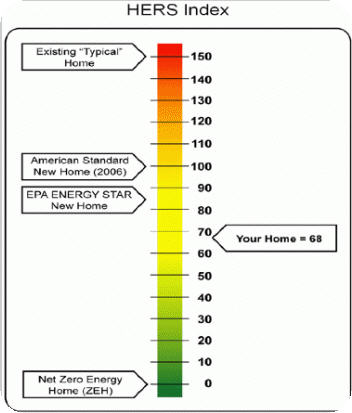
What: The Home Energy Rating System is a score for energy use that is designed to make it easier for consumers to compare homes. It’s often compared to the EPA fuel-efficiency stickers seen at new car dealerships — only for houses.

How does it work: The lower the index score, the more energy-efficient a home is. A new home that conforms to minimum current efficiency standards typically scores 100. By comparison, a home with a score of 70 should consume only 70 percent as much energy.

Can a low HERS score add value to your home?  Contact the appraisers at www.scappraisals.com for your value questions.  Southern California Appraisal Services is the West’s forerunner in green and energy-efficient property appraisals.

Who uses it: The score is recognized by the Department of Energy and the Environmental Protection Agency, and it is gaining influence among homebuilders and mortgage lenders. The Oceanside-based nonprofit Residential Energy Services Network oversees the training of independent contractors to rate homes fairly and consistently. RESNET also helps foster market demand for home energy ratings.

Q: When does the energy score come into play?

A: One of the things we’re asking of consumers is to know your score when you’re shopping for a home, so that you can tell the relative efficiency from one home to the other. Why is this important? Government-sponsored mortgage lender Fannie Mae has found that the cost of heating, cooling and hot water for a home is the highest cost of homeownership outside the mortgage loan.

Read entire article at: http://www.utsandiego.com/news/2013/mar/01/tp-keeping-score-with-energy/?page=1

Disclaimer:  for information and entertainment purposes only