Tag Archives: energy savings

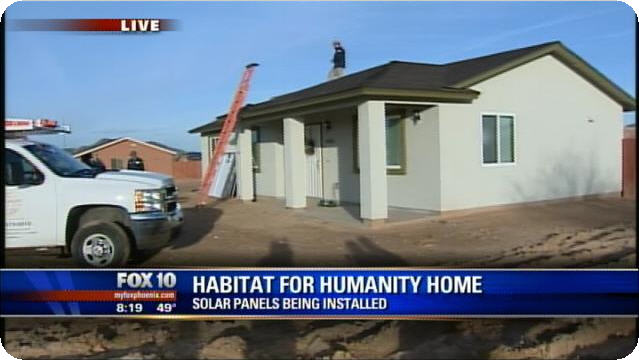
Builders and Consumer Perceive Green Home as Affordable to Live in – Expensive to Build?

habitat

New Survey From Whirlpool Corporation and Habitat for Humanity International Also Find Consumers Believe Savings may be Worth the Expense

Green homes offer a wide variety of benefits from reducing carbon footprints to saving money on utility bills to even improving the health of children. However, a recent Whirlpool Corporation and Habitat for Humanity survey conducted by the NAHB Research Center (a subsidiary of the National Association of Home Builders), polled home builders, as well as consumers, and found many believe there’s a disconnect between living in a green home and purchasing one. Yet, the majority of respondents (64 percent) indicated that savings from green home features were sometimes worth the added costs and efforts. This finding was consistent across all income level groups for both renters and homeowners.

Does energy efficiency add value to your home?  Contact the appraisers at www.scappraisals.com for your value questions.

It’s a particularly difficult position for the majority of homeowners in the United States. The consumer survey, fielded in August 2010 by the NAHB Research Center to gauge perceptions of affordable and green housing, found that the majority of High (67 percent), Upper Middle (65 percent), and Middle (59 percent) income respondents, as well as nearly half of low income respondents (48 percent), indicated they believe a completely green home would be affordable to live in or maintain. Yet only high-income respondents were more likely to indicate that a completely green home would be affordable to purchase (71percent).

“The health benefits, low utility costs and other factors make green homes ideal for all homeowners. However, it takes a united front of manufacturers, builders and organizations to help builders and consumers understand that building green can be affordable,” said Tom Halford, general manager, contract sales and marketing, Whirlpool Corporation. “There’s a need to bridge the perception gap between green-building and affordability, so that builders and families understand that options exist to improve their footprint in the long-term, while saving money and resources in the short-term.”

The builder survey, fielded July-August 2010 to members of the Research Center’s Online Builder Panel, found that 87 percent believe green homes are affordable for middle income families to live in, while 30 percent felt green homes were too expensive for the segment to purchase or build. For low-income families, 70 percent of home builders believe green homes are affordable to live in, and nearly 60 percent of builders thought green homes were too expensive for low-income families to purchase or build.

Read more at: http://oikos.com/news/2010/12.html#affordable

Disclaimer: for information and entertainment purposes only.
Rebates and Efficiencies Help Residents Save Energy and Cash

denver

Save Energy

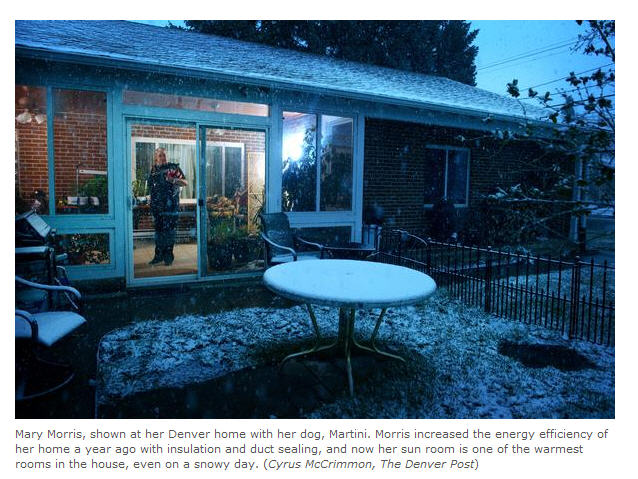
Mary Morris was wary when she had to pay for an energy audit of her single-family home in the North Park Hill to qualify for an Xcel rebate.

Twelve months later, she’s a convert. Since contractor Casey Staley from REenergizeCO completed an energy audit on her home, which was built in 1948, and performed subsequent improvements last spring, Morris has saved $438 on her energy bill. That’s in addition to Staley finding $1,100 in rebates for a $3,800 project.

Will energy efficiency add value to your home?  Contact the appraiser at www.scappraisals.com for your value questions.

“For $2,700, we got the audit, our duct work in the attic sealed with flexible mastic, and I could sense an improvement in the air quality within 24 hours,” she says.

With that money Morris also insulated the attic as well as a 1,700-square-foot main floor that included a large sun room, and weatherized a nearly 1,500-square-foot “bomb bunker” basement, where Staley added a threshold to her energy-sucking boiler room. The money also went toward purchasing an energy-efficient dishwasher.

Staley, who’s a vetted contractor through Xcel and Denver Energy Challenge, works to make sure his clients receive all rebates possible. He says residents are often unaware of how much money they can save on up-front costs. He added that residents who performed home improvements saw additional savings in their tax returns this year through a federal credit.

“That tax credit is 10 percent,” he said. “If the work is $4,000, you’re getting $400 back from the (feds).”

Morris, who received around $300 back from the tax credit this year, looks forward to a summer where her air conditioner will keep her home at a comfortable 71 degrees. “My husband says the sign of a civilized life is when you’re warm in the winter and cool in the summer,” she says. “And I agree.”

Read more: Rebates and efficiencies help residents save energy and cash – The Denver Post http://www.denverpost.com/smart/ci_23066169/rebates-and-efficiencies-help-residents-save-energy-and-cash#ixzz2RJGD8GPW

Disclaimer: for information and entertainment purposes only

Navy Begins Power Metering – Military Families Could Get Power Bill

military

After never seeing a power bill, San Diego families in military housing will start getting invoices for their electricity use later this year.

They won’t have to cover the entire cost. But military families who crank up the air conditioning or leave all the lights on — at least 10 percent more than the average user — will owe for the excess.

Contact the appraisers at www.scappraisals.com for a free handout on easy ways to save energy in your home.  The appraisers at Southern California Appraisal Services are Certified Energy Analysts.

In Hawaii, the first Navy region to try the power-metering concept in 2011, about a third of military homes receive a monthly invoice averaging more than $60.

On the flip side, energy-saving households get cash back as an incentive. About a third of Hawaii families use less than the average amount and get monthly rebates averaging $57.

All told, the Navy has cut power use by 10.5 percent in Hawaii. About 15 million kilowatt-hours have been conserved, equaling $3.3 million.

The savings in San Diego are expected to be about the same, though electricity is less expensive here. It will cost $3 million to install power meters in older homes that lack them.

The change is driven by a 1998 Pentagon directive that ordered energy conservation at housing complexes managed by public-private joint ventures — in San Diego County, basically all military family housing constructed over the past decade.

Read more at: http://www.utsandiego.com/news/2013/apr/08/tp-navy-begins-power-metering/

Disclaimer: for information and entertainment purposes only