Tag Archives: ventilation

Natural Cooling Strategies

cooling

Most people have limited tolerance for hot weather. As the thermostat rises, we quickly become uncomfortable, and if it becomes too hot inside our homes, it’s even dangerous. Our modern response to this problem is simple: “Turn up the air!” However, air conditioning consumes a lot of electricity, and most of it comes from polluting fossil fuels. Electricity is also a limited resource: On the hottest days of the year, some cities don’t have enough electricity to meet demand, leading to brownouts or rolling blackouts.

Contact the appraisers at www.scappraisals.com to determine if saving energy add value to your home.


Fortunately, many old-fashioned design strategies can keep a house cool naturally, which conserves energy and saves money. Although home builders largely have stopped using these techniques over the past 100 years, there’s no reason we can’t rediscover them and use them in our homes. This article explains how to use a few basic natural cooling strategies, whether you’re building a new house or making improvements to an existing home.


Natural Ventilation


Before society embraced air conditioning, we all found simple ways to beat the heat. One was to sit on a shaded porch, sipping a cold drink. If the porch was positioned correctly, gentle breezes would blow past. Breezes help moisture evaporate from your skin — one of the body’s main methods for cooling off. In fact, many natural cooling techniques boil down to one basic principle: Keep the air moving. So how do you improve airflow within your home?

Read more: http://www.motherearthnews.com/renewable-energy/natural-cooling-zm0z11zphe.aspx?newsletter=1&utm_content=05.24.13+GEGH&utm_campaign=2013+GEGH&utm_source=iPost&utm_medium=email#ixzz2UK3uVy3I

Disclaimer: for information and entertainment purposes only.
Control Air Movement – Save Energy

The control of air movement—the reduction of uncontrolled air leakage and the inclusion of controllable ventilation—is essential to minimise the need for supplementary heating and cooling. This can save up to 20% on heating and cooling costs and improve comfort.

Contact the appraisers at www.scappraisals.com for questions about savings equaling increase in value.

Air leakage has a significant impact on thermal performance. This should be minimised by draught proofing new and existing homes. This can prevent heat loss in winter, thereby saving on the cost of heating, and prevent the entry of warm air in summer, reducing the need for cooling.

A typical home with a wall vent in each room will have approximately one air change per hour (one air change per hour occurs when the volume of inside air is replaced totally by outside air in a period of an hour). Sealing the vents reduces the air change rate to 0.5 per hour, which reduces overall energy requirements by up to 15% and still allows for adequate ventilation.

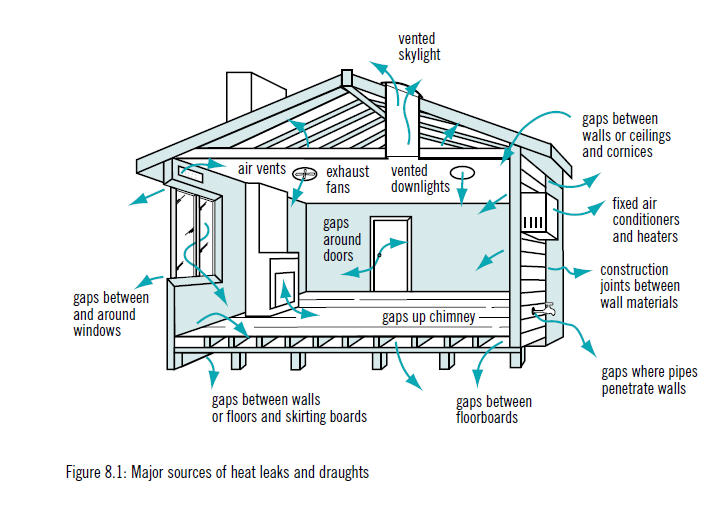
Many older homes have significant air leakage, which can average up to three air changes per hour. Some typical sources of air leakage are shown in figure 8.1. Limiting air leakage in older homes can save up to 25% of heating energy costs.

Ventilation should be planned to cool the home and its occupants in summer, and reduce or eliminate the need for mechanical air conditioning.

Read more at: http://www.sustainability.vic.gov.au/resources/documents/ESHousingManualCh08.pdf

Disclaimer: for information and entertainment purposes only

1 Way of 24 Ways to Save Energy Now

#11 of the series

Add ventilation – Not all with older homes have installed exhaust fans in both the bathroom and the kitchen.  But this kind of spot ventilation will improve the overall efficiency of a whole-house systems.  Make sure you get an energy-star rated star fan and get a professional to install.

Disclaimer: For Information and Entertainment Purposes Only