
Category Archives: energy retrofitting

Solar-Powered Showdown

solar

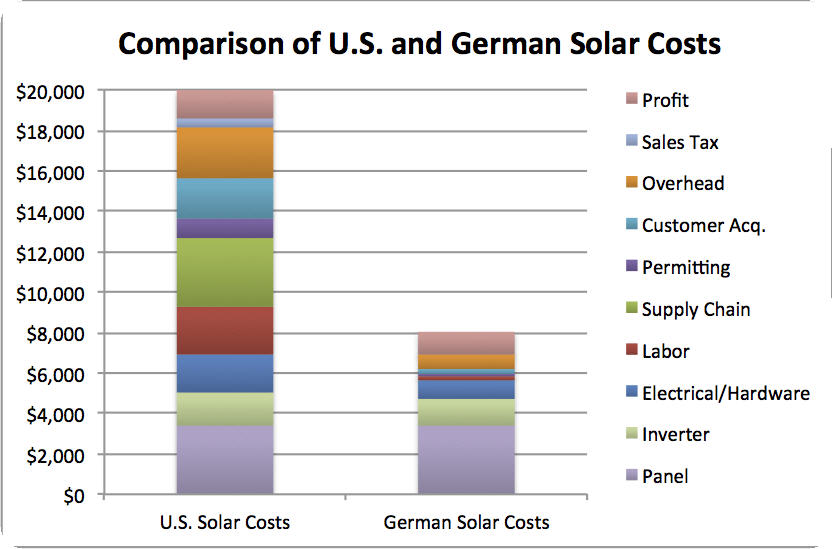
The European Union announced Tuesday that it is imposing anti-dumping levies on imports of Chinese solar panels, in a move that could trigger a trade war between two of the world’s largest economies.


EU Trade Commissioner Karel De Gucht said the 27-nation bloc will impose a tariff of about 12 percent on the import of solar panels, cells and wafers from this week, increasing it to an average of 47 percent in August unless a settlement is reached with China in the next 60 days.

Does the manufacture of your solar panels effect the value of your system?Contact the appraisers at www.scappraisals.com for your value questions.


China, the world’s largest producer of solar panels, is accused by the EU of selling them below-cost — a tactic known as dumping — to corner the market. Its exports of solar panels to Europe totaled 21 billion euros ($27.5 billion) in 2011.


The cheap Chinese products are flooding the market and threaten to bring down EU manufacturers, De Gucht said in Brussels, Belgium.


According to EU calculations, a fair sale price for Chinese solar panels should be 88 percent higher than what they are being sold for.


“It has the potential to destroy an important industry in Europe if we don’t act today,” he added, noting that more than 20,000 jobs in Europe are at stake.


China rejects the EU’s price-dumping allegations. Chinese Premier Li Keqiang warned last month imposing punitive tariffs would hurt European consumers and might encourage trade protectionism — although he stopped short of threatening retaliation.


The EU is China’s second-biggest business partner after the U.S. Solar panel exports in 2011 stood for about 7 percent of China’s total exports to the EU.

Read more at: http://www.utsandiego.com/news/2013/jun/05/tp-solar-powered-showdown/

Disclaimer: for information and entertainment purposes only
Green Buildings for Tough Times

leak

Start with the basic principles that govern how energy crosses a building enclosure: convection (air leakage), conduction (movement through walls, for example), and radiation (of sunlight through windows, for example). I choose building components that best address energy flow by design, and that require proper installation, but not extra labor and skills, to make them work.

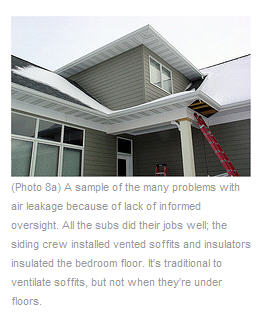
Can we build an energy-efficient, stick-framed envelope insulated with fiberglass? Sure, but it takes a lot of work and requires skill, persistence, and a ton of caulk. Air leaks through stick-framed walls at the top and bottom plates; between the drywall and the sheathing; around windows and doors; and through light fixtures, switches, and outlets.

Does energy efficient upgrades add value to your home?  Contact the appraisers at www.scappraisals.com for your value questions.


We can still use stick framing and dramatically reduce air leakage with properly applied sprayed polyurethane foam, reducing the need to caulk holes from wiring or plumbing. Foam costs 3 or 4 times as much as fiberglass, but if it’s applied as directed, it fits tightly, insulates, and doubles as an excellent air seal—far better than fiberglass. If we’re concerned about heat loss through studs, we can either  shear the exterior with rigid foam sheathing, or better yet, use SIPs, which eliminate a great deal of framing lumber.


I spray open-cell foam directly to the underside of the roof deck, from the ridge down to the tops of the walls, creating a conditioned attic. This stops air leakage to the outside through any penetration in the ceiling, eliminates the need for roof ventilation, and does not, in my opinion, lead to premature deterioration of the shingles. All HVAC supply and return ducts are within the conditioned space, access to plumbing and wiring in the attic is simplified, and recessed ceiling lights need not be airtight or protected from insulation. Admittedly this insulation method costs more, both because foam costs more than fiberglass, and because there’s more surface area to cover. Nevertheless, foam seals out air leakage better than fiberglass, and the home’s energy performance is greatly improved.

Read entire article at: http://www.homeenergy.org/show/article/magazine/130/nav/issues/id/1868?utm_source=June+4%2C+2013+e-newsletter&utm_campaign=HEM+Enewsletter&utm_medium=email

Disclaimer: for information and entertainment purposes only
Builders and Consumer Perceive Green Home as Affordable to Live in – Expensive to Build?

habitat

New Survey From Whirlpool Corporation and Habitat for Humanity International Also Find Consumers Believe Savings may be Worth the Expense

Green homes offer a wide variety of benefits from reducing carbon footprints to saving money on utility bills to even improving the health of children. However, a recent Whirlpool Corporation and Habitat for Humanity survey conducted by the NAHB Research Center (a subsidiary of the National Association of Home Builders), polled home builders, as well as consumers, and found many believe there’s a disconnect between living in a green home and purchasing one. Yet, the majority of respondents (64 percent) indicated that savings from green home features were sometimes worth the added costs and efforts. This finding was consistent across all income level groups for both renters and homeowners.

Does energy efficiency add value to your home?  Contact the appraisers at www.scappraisals.com for your value questions.

It’s a particularly difficult position for the majority of homeowners in the United States. The consumer survey, fielded in August 2010 by the NAHB Research Center to gauge perceptions of affordable and green housing, found that the majority of High (67 percent), Upper Middle (65 percent), and Middle (59 percent) income respondents, as well as nearly half of low income respondents (48 percent), indicated they believe a completely green home would be affordable to live in or maintain. Yet only high-income respondents were more likely to indicate that a completely green home would be affordable to purchase (71percent).

“The health benefits, low utility costs and other factors make green homes ideal for all homeowners. However, it takes a united front of manufacturers, builders and organizations to help builders and consumers understand that building green can be affordable,” said Tom Halford, general manager, contract sales and marketing, Whirlpool Corporation. “There’s a need to bridge the perception gap between green-building and affordability, so that builders and families understand that options exist to improve their footprint in the long-term, while saving money and resources in the short-term.”

The builder survey, fielded July-August 2010 to members of the Research Center’s Online Builder Panel, found that 87 percent believe green homes are affordable for middle income families to live in, while 30 percent felt green homes were too expensive for the segment to purchase or build. For low-income families, 70 percent of home builders believe green homes are affordable to live in, and nearly 60 percent of builders thought green homes were too expensive for low-income families to purchase or build.

Read more at: http://oikos.com/news/2010/12.html#affordable

Disclaimer: for information and entertainment purposes only.