
Category Archives: Real Estate

What Buyers Need to Know About a Home Inspection

: When buying a home, is there anything in the home inspection that the seller must fix before the completion of the sale?

How does the seller know the contents of the inspection

A: That’s a very good question. First, when you sign a contract to buy a house (whether it’s an existing or a newly built home), it should contain a home inspection contingency. A contingency gives you the right to cancel the sales contract and get your earnest money refunded if a particular condition is not met.

Will the home inspection effect the value?  Contact the appraisers at www.scappraisals.com

There are, from my experience, two kinds of home inspections contingencies: (1) if the home inspector finds problems, regardless of what they are, you have the absolute right to back out from the sales contract; or (2) if the inspector finds problems, you present those to the seller and give him X number of days to correct or give you a cash credit. If the seller refuses, you can then decide whether to go forward with the purchase or walk away.

Personally, I like the first option; it gives the buyer a “cooling off” period. All too often, real estate contracts are entered into late at night when the buyer is both on an emotional high but at the same time emotionally drained.

Regardless, however, do not let anyone convince you not to have a home inspection. I have represented too many buyers who failed to get their house inspected only to find major (or minor) problems that could have been corrected before closing.

A good real estate agent should provide you with the names of at least two home inspectors.

You want to make sure that the inspector you use will be independent and not a mouthpiece for the real estate service that gives him the business.

read more at:http://www.chicagotribune.com/classified/realestate/ct-mre-1104-benny-kass-20121101,0,6248870.column

Disclaimer: for information and entertainment purposes only
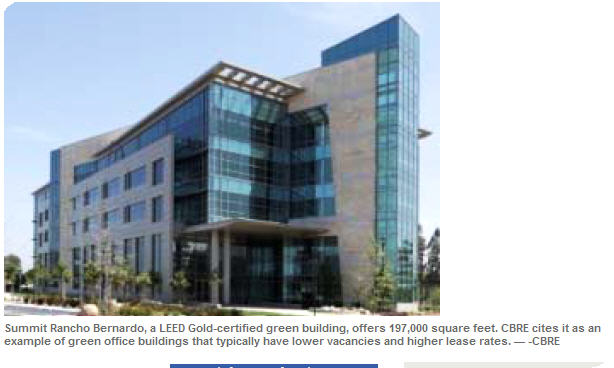
Green Buildings Outperformed in Vacancy, Rental Rates

Green” is better when it comes to lower vacancy rates and higher rents, according to the CBRE brokerage in San Diego.

CBRE looked at buildings with LEED certification or Energy Star ratings. LEED stands for Leadership in Energy and Environmental Design, a ratings program by the U.S. Green Building Council. Energy Star is a rating system by the U.S. Energy Department.

As of June 30, green buildings overall were 11.7 percent vacant compared with 15.7 percent of nongreen buildings.

The lease rates on average were $2.42 per square foot per month, compared with $2.04 for nongreen.

“Green buildings continue to outperform non-green buildings in the San Diego market,” CBRE said in its recently released MarketView quarterly report.

The gap is less for Class A and B buildings, those that charge the most rent and offer the best locations and amenities. Nongreen buildings in this category charge an average $2.24 per square foot. Virtually all green buildings are Class A or B, said CBRE Research Manager M. Lawrence Kopp

Read more at: http://www.utsandiego.com/news/2012/sep/05/green-buildings-outperform-vacancy-rental-rates/

Disclaimer: for information and entertainment purposes only

Check Growth Size before You Plant Trees and Shrubs

Do trees add value to your property?  Depends.  What I can tell you is when I see a large, beautiful tree on someones property I look at the canopy. The rule of thumb is the canopy is half the size of the root system.  If the tree is close to the home then I start to look for the plumbing main.  Many homes have to have the main replaced because roots have grown into the main and damaged the pipes.  Roots have been known to crack foundations and grow into walls.  Before you buy a home that has many trees and plants on the property you may want to have your local plumber use a scope to check the integrity of the pipes. 

Contact the appraiser at www.scappraisalserv.com for you value questions.

Including trees and shrubs at your home to add shade and privacy is a long-term commitment. There are many important factors to consider when choosing these plants, and you must think ahead. “Fast growing” and “large” are great qualities, but here are a few things to consider with trees and shrubs:

• Choose the right size for your space. Always look at the height, width and maturity rate of the tree or shrub before you plant. Consider the proportions of your home; you don’t want a tree or shrub blocking a path or growing in areas you did not intend.

• Don’t forget about roots! Some shallow-rooted trees can cause damage to your home, walls, patios, or sidewalks.

• Camphor, jacaranda, elm, Southern magnolia, and liquidambar are great large trees to choose for wide open spaces, while purple leaf plum, orchid, crape myrtle and dwarf magnolia are perfect for smaller homes.

• Consider the seasons. Evergreen trees keep their growth year-round, while deciduous trees lose their leaves in the winter. (Deciduous are great for saving on heat costs because they allow the sun to hit your home.)

• Before you plant, be aware of how they may bloom. Fallen flowers or seed pods can track easily into the home or create a mess.

• Create extra privacy for your home with shrubs, including cape honeysuckle, Texas privet, acacia and purple hopseed that have great height and width.

• If you do not have room for shrubs or trees, consider mounting a trellis on an existing fence with white or pink bower vines for privacy.

Be sure to water your trees and shrubs regularly after planting (especially in hot weather), fertilize as directed, and consult your local nursery professional about the types of trees or shrubs that are the most insect- and disease-resistant for your area.

Thanks to Patty Cordero is a California Certified Nursery Professional and the manager of the Armstrong Garden Centers located in Mission Valley for some of the content.

Disclaimer for information and entertainment purposes only.