
Category Archives: recycling

Portland Recycling Guru; Fills One Can of Trash in 16 Months

Taking 16 months to fill one 35-gallon can with trash is the best the Shelleys have done so far in reducing their waste.

They wrote no blog chronicling a year of sudden, anti-garbage inspiration with panicked Styrofoam-meat-tray-crinkly-cereal-box-liner moments. Instead, their effort to cut back on waste started slowly more than 20 years ago with the question: Where is “away” when something is thrown away?

That led to habits Jon Shelley says now come as naturally as breathing, making their feat not much trouble at all. But how does someone else get to that point?

A recycling information specialist at Metro, Betty Shelley heard that question enough she decided to teach a three-part class on reducing waste.

In “Less is more: Getting to one can of garbage a year,” she details her many habits and explains how, most importantly, she carefully considers what she brings home, asking, Where will it go when it’s used up, served its purpose or breaks?

Because while recycling matters, reducing consumption reigns.

Read more at: http://www.oregonlive.com/living/index.ssf/2013/02/16_months_one_can_of_trash.html

Disclaimer:  For information and entertainment purposes only
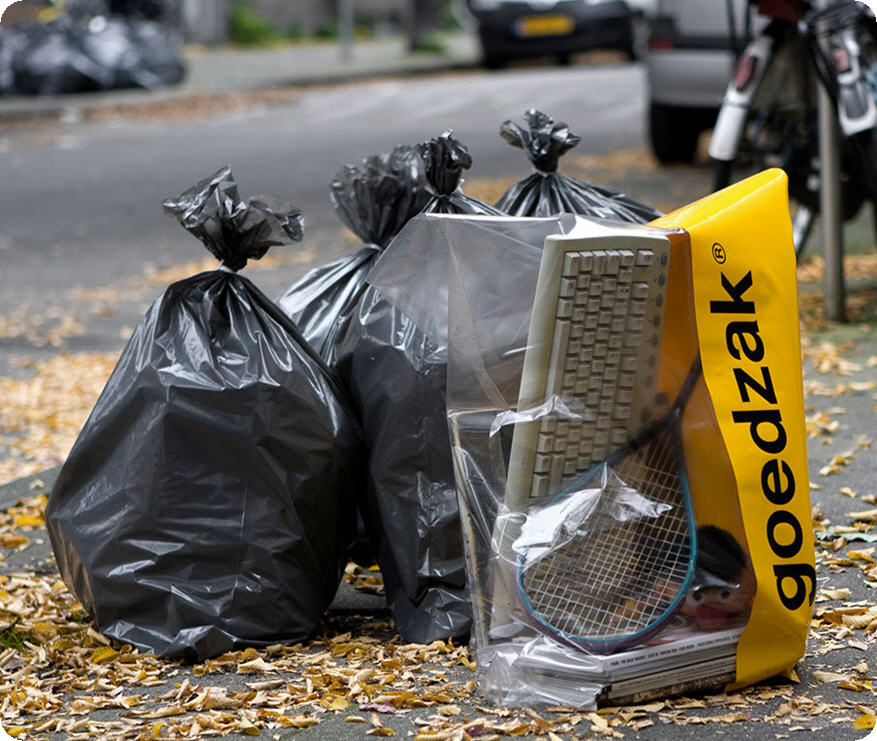
The Goedzak is a Garbage Bag That Invites Freecycling

garbage

It’s a dirty little secret that discarded household items still useful enough to take to Goodwill are sometimes set out in the curbside trash instead. At times, it’s because of the pressure of rushed lives. Other times, that ugly old lamp or broken chair might not seem to its owner to have any value left.

The Goedzak — think “good sack” — is a way to let your neighbors decide whether those unwanted items still have some life left in them. The clear plastic makes the stuff visible to every passer-by in an open invitation to curbside freecycling.

The design, by Simon Akkaya of Amsterdam design studio Waarmakers, resulted from his graduation project — engagingly titled “Design for Altruism” — at Delft University of Technology. “My goal was to design products that stimulate people to act to benefit others, preferably complete strangers,” he writes on the Waarmakers website.

He explains there that “everybody owns items that are no longer of value to them. Every now and then we throw out these items, while they still might be of value and/or useful to others. These items disappear in grey garbage bags and end up on trash piles. Goedzak offers these items a second chance. Goedzak stimulates people to dispose of their products in a more conscious and sustainable way. Goedzak can extend the products’ lifetime.”

Read more at: http://www.oregonlive.com/hg/index.ssf/2013/01/one_cool_or_crazy_thing_the_go.html

Disclaimer: for information and entertainment purposes only

California Launches Paint Recycling Program

A California law that went into effect Friday, Oct. 19, requires paint manufacturers to develop a take-back system for leftover paint from household and commercial consumers.

The new California Paint Stewardship Program will be the second of its kind in the United States. Oregon’s pilot program started two years ago. Connecticut and Rhode Island are planning similar programs.

Paint manufacturers, through the American Coatings Association, created PaintCare, a nonprofit organization to administer the state programs. The nonprofit will arrange for recycling and proper disposal of unused paint and conduct public education about proper paint management.

More than 700 million gallons of architectural paint are sold each year in the U.S., and about 10 percent is available for recycling. Until now, leftover paint has been handled primarily by government-run household hazardous waste programs.

“This program will make proper paint management more convenient for the public by setting up hundreds of new paint drop-off sites at retailers throughout the state,” said Marjaneh Zarrehparvar, executive director of PaintCare. “It will also help local governments that partner with PaintCare by paying for the paint they already accept through their household hazardous waste programs.”

Funding for the program will come from a recovery fee that will be applied to the purchase price of paint sold in California and paid to PaintCare.

Fees are based on container size as follows: No fee for a half-pint or less; 35 cents for paint that is more than a half-pint but less than a gallon; 75 cents for a gallon, and $1.60 for paint that is more than a gallon and up to 5 gallons.

PaintCare will use the fees to pay for the transportation of leftover paint from partnering drop-off sites to processors for recycling and energy recovery.

For more information about the California Paint Stewardship Program or to find out where you can recycle your own paint, visit www.paintcare.org.

Disclaimer: for information and entertainment purposes only