
Category Archives: Renewables and Energy

Lawmakers are tinkering with electricity again

With San Diego Gas & Electric Co. lobbying ferociously, the California’s Legislature is poised to approve the first overhaul of electricity rates since 2001. Somebody’s going to get hurt.

By itself, this isn’t remarkable. Our system of regulating utilities creates winners and losers any time the government tweaks the way power costs are spread out among consumers.

How will utility rates effect the value of your home?  Contact the appraisers at www.scappraisals.com for your value questions.

What’s different this time is technology. Lawmakers, and eventually regulators at the Public Utilities Commission, are wrestling with the advent of “smart meters,” the first major advance since the days of Thomas Edison.

In theory, smart meters make it possible for consumers — or their networked appliances — to see the hourly swings in power prices and adjust their lives accordingly.

If the price goes way up on a summer afternoon, my neighbor can just set his pool pump to run after midnight, when air conditioners aren’t running and power is dirt cheap.

Shifting peak consumption statewide by 10 percent or so would allow California to avoid building relatively inefficient, polluting “peaker” generators, and rely on its massive investments in wind and solar power.

That’s theory, anyway. Nearly all of the expensive smart meters installed in recent years don’t show prices.

Utility executives and their PUC regulators are terrified of mandating true price transparency.

Electricity is the world’s most volatile commodity. Prices in the daily spot market can hover near zero at 3 a.m. and shoot to $1.50 a kilowatt hour on a hot summer afternoon, when air conditioners kick on and the state flirts with shortage.

Most of the state’s power is bought on long-term contracts, so smart meters wouldn’t go that crazy under even the most wild-eyed free market scenario.

Still, economists and efficiency advocates have been rooting for widespread “time-of-use” pricing for years. Recent results from pilot programs suggest that households will cut their peak consumption by 15 percent if they can see and understand when prices surge.

Yet utility and executives remain wary of blowback.

Read more at: http://www.utsandiego.com/news/2013/aug/17/look-out-lawmakers-tinker-with-electricity-again/all/?print
Sempra Earning Up In 2nd Quarter

Earnings are up at San Diego-based utility holding company Sempra Energy despite a $119 million charge for the retirement of the San Onofre Nuclear Generating Station. Sempra subsidiary San Diego Gas & Electric owns a 20 percent stake in the North County plant.

Sempra on Tuesday reported profits of $245 million for the April through June period, up from $62 million in the same time in 2012 when the company experienced a $179 million write-down on its investment in the Rockies Express pipeline.

Profits were elevated by $106 million with the approval by utility regulators of a four-year rate increase at SDG&E and Southern California Gas. The rate increase will show up on SDG&E customer bills starting Sept. 1, though it applies retroactively to the start of 2012.

Sempra said its financial performance increased excluding the charges and rate-case adjustment, with adjusted earnings rising 7 percent to $258 million in the second quarter.

San Onofre majority owner and operator Southern California Edison made the decision to retire the nuclear plant in June, more than a year after problems emerged with recently replaced steam generators that were intended to extend the life its two reactors.

read more: http://www.utsandiego.com/news/2013/aug/07/tp-sempra-earnings-up-in-2nd-quarter/

Greater Efficiency for Solar Panels

solar

One thing a solar panel shouldn’t do is reflect the sun — for every photon that bounces off is one less electron of electricity the panel will create.

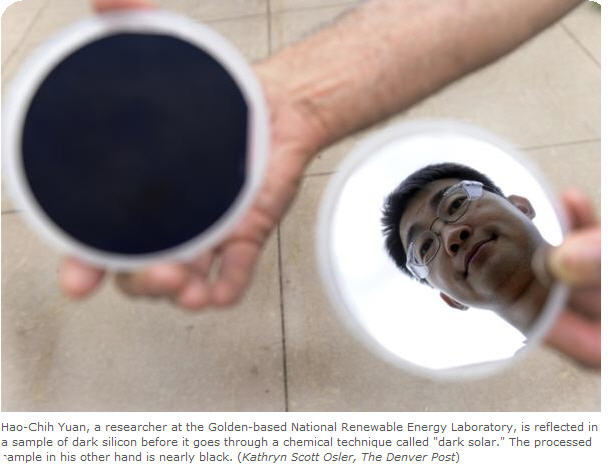
How to make that panel less shiny? Researchers at the Golden-based National Renewable Energy Laboratory have come up with a solution: peppering a cell with trillions of tiny holes.

The technique dubbed “dark solar” has been licensed to Red Bank, N.J.-based Natcore Technology Inc., which is combining it with its own low-cost solar-cell-manufacturing process.

Does solar add value to your home? or did you not credit  for having solar on your home on your last appraisal?  Contact the appraisers at www.scappraisals.com

“It’s a perfect coupling of technologies,” said Natcore CEO Chuck Provini.

American solar-panel makers have been under pressure as prices dropped more than 50 percent in the past five years because of a flood of inexpensive Chinese solar panels.

The question is whether American manufacturers can come up with a technological counterpunch, Provini said.

A flat silicon surface without any treatment will reflect 35 percent of the sunlight that hits it, said Hao-Chih Yuan, an NREL researcher.

That’s why solar manufacturers coat the panels using an expensive and toxic gas-deposition system.

Even with that, about 7 percent of the light still bounces off a poly-silicon cell.

Read more: NREL pursues greater efficiency for solar panels – The Denver Post http://www.denverpost.com/breakingnews/ci_23317867/nrel-pursues-greater-efficiency-solar-panels#ixzz2UJz0v8Do

Disclaimer: for information and entertainment purposes only.