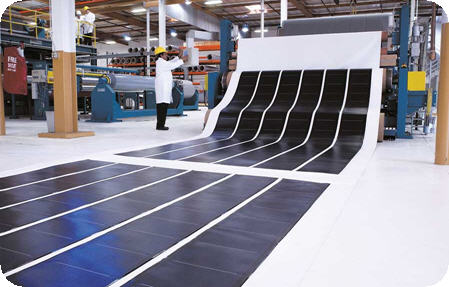
The type of solar-electric module currently dominating the industry is crystalline silicon, which is made by encapsulating wafers of highly refined silicon under rectangular sheets of glass framed with aluminum. These modules have been the primary solar energy technology for more than 50 years. Since the invention of the first modern silicon solar cell in 1954, incremental improvements have resulted in modules capable of converting 12 to 18 percent of solar radiation into electricity.
Crystalline modules still dominate in PV sales, but in the last few years most new development work has focused on thin-film PV technologies. In 2005, more than 95 percent of the PV market was served by crystalline modules. Since then, thin film’s share of the market has risen steadily and is now 25 percent. Hundreds of thin-film companies have entered various stages of product development or production.
Large-area thin-film PV modules and laminates have been commercially available since the ’90s, and the current products have conversion efficiencies of 6 to 11 percent. The higher the efficiency, the less area and support structure required to produce the desired amount of electricity, so it’s worth noting that, overall, thin-film modules still aren’t as efficient per unit area as crystalline silicon modules. However, thin-film PV has other advantages over crystalline silicon. Perhaps most importantly, thin-film solar is much less expensive to produce. Many thin-film panels are produced from amorphous silicon. These solar cells require much less high-grade silicon than it takes to produce crystalline silicon panels. Thin-film solar cells can also be made from other semiconductor materials, including copper indium gallium diselenide (CIGS) and cadmium telluride (see “Four Thin-film Solar Technologies,” below).
Going Solar in a Big Way: Utility-scale Thin-film Projects
A critical question in the field of renewable energy is when utility-scale photovoltaics will reach grid parity — the point at which PV power will be cost competitive with electricity from fossil fuels. In fact, utility-scale PV power is already cost-competitive with nuclear energy, but is not yet as cheap as electricity produced from other sources, such as coal.
While many PV manufacturers are successfully reducing costs, the current low-cost leader in the field of utility-scale solar power is First Solar, which is based in Tempe, Ariz. First Solar was on track to produce more than 1 gigawatt (GW) of cadmium telluride on glass modules in 2009. For perspective, 1 GW would be equal to about 250,000 large home-scale PV systems.
The First Solar modules averaged 10.9 percent efficiency in 2009 — making them among the most efficient of thin-film products. The company has also overcome concerns about the heavy metal cadmium used in its modules with a recycling program that keeps this toxic material out of the waste stream.
Over the past several years, First Solar has lowered the manufactured cost of its product from $3 to $.85 per watt. This is close to half the manufactured cost of crystalline modules and most other thin-film PV products on the market. First Solar has also dramatically reduced the balance of system costs to $1.10 per watt. That figure includes wiring, inverters and mounting structures — essentially everything but the PV modules. The company’s cost-cutting approach also includes reducing the permit and installation time on utility-scale projects from years to months. Initial side-by-side comparisons show a 10 to 15 percent savings in installed cost with First Solar modules and about a 10 percent greater output than crystalline modules with the same rated capacity. Over the next five years, First Solar is committed to increasing the efficiency of its modules to 15 percent, decreasing its manufacturing costs to $.52 per watt and decreasing its balance of system costs to $.95 per watt. If the company is successful in meeting these goals, utility-scale PV power will be as cheap as power from fossil fuels.
Can We Make Every Roof a Solar Roof?
A future with more utility-scale solar power plants will be a step in the right direction — more consumers will have the option to purchase green power. But control of power production would remain in the hands of a few large corporate and municipal utilities. In addition, getting the power from areas with the best solar resources, such as the Southwest, to the areas of the country with less sunshine will require a vast network of costly transmission and distribution lines, along with other infrastructure to store excess power and release it as needed. The alternative to centralized power production is distributed generation. Rather than building massive new power plants, why not install PV panels on every sunny roof and over every parking lot? (See photo in the Image Gallery.) I’m convinced that with the amount of parking lot and roof space available in the United States, we could capture enough solar energy to provide all the electricity we need, including enough to charge a national fleet of electric cars. The same mass adoption that allowed room-sized mainframe computers to morph into laptops could cause huge, centralized power plants to give way to rooftop PV panels. In fact, some U.S. policies already encourage distributed generation by giving substantial tax incentives to homeowners and businesses that install PV systems (see Solar Resources, below).
Because thin-film solar panels are both lightweight and flexible, it’s possible to incorporate them directly into buildings — as roofing materials, for example. The idea of building-integrated photovoltaics is not new. Architects have been using PV modules as roofing since the early ’80s, but using the glass modules available at that time was both challenging and expensive. Glass is transparent, long-lasting and weatherproof, but it can shatter and is not an ideal roofing material.
For more than a decade, Uni-Solar’s amorphous silicon thin-film laminates have been demonstrating the advantages of using thin-film solar cells on rooftops. In 2001, Solar Integrated Technologies (SIT) developed a process for bonding Uni-Solar laminates to membrane roofing used on flat roofs on commercial buildings. SIT became the first of many roofing companies to work with PV manufacturers to make products that serve the dual functions of providing a weather-tight surface and generating power. In August 2009, Uni-Solar announced a merger with SIT. In October 2009, CertainTeed, a leading North American manufacturer of asphalt shingles, announced an agreement to develop roofing-integrated PV products for the residential market. In September 2009, Dow Building Solutions announced it is working with Global Solar, a leading manufacturer, to develop 10 percent efficient thin-film solar roofing shingles.
Many other possibilities exist for building-integrated photovoltaic applications. In some cases, glass PV modules can replace architectural elements such as awnings and facades, and a few companies are producing thin-film modules that can be used as windows. There is also great potential for developing low-cost solar siding. For every new technological development that’s announced, there are dozens more in the works. Future generations will wonder why people ever used fossil fuels to produce electricity. But you don’t have to wait for the future — check out the Solar Resources list below to learn about options for your own thin-film PV project.
Four Thin-film Solar Technologies
Currently, four semiconductor materials are used in the thin-film PV industry. Which one will eventually win out? That will depend on the results of continued research and development.
1. Amorphous silicon was first developed in the ’70s by Stan Ovshinsky, the co-founder of Energy Conversion Devices (ECD), and it became the material of choice for charging consumer products such as watches and pocket calculators. ECD’s solar division, Uni-Solar, produces amorphous silicon — flexible thin film that can be bonded to roofing products such as standing seam metal or flexible membrane roofing. This product has a real-life conversion efficiency of 8.5 percent and a maximum efficiency of 15 percent when tested in the lab. In spite of relatively low efficiency per unit area and high manufactured cost (around $2 per watt), the unique ability of these laminates to adhere to roofing products has made Uni-Solar the leader in flexible thin film for more than a decade. This dominance will probably soon be challenged by manufacturers who will use less expensive deposition and encapsulation techniques, or will develop products that do not require roofing as a substrate. Many companies are attempting to compete in the rigid PV module market with amorphous silicon deposited on glass, but none will likely survive unless they can challenge the low-cost records set by First Solar with CdTe (see below).
2. Copper indium gallium diselenide (CIGS) was developed in the ’80s as an alternative to amorphous silicon. It has high efficiencies — 11 percent real life and 20 percent lab — but CIGS degrades rapidly in the presence of moisture. This has led several companies to encapsulate their flexible cells under glass. The trade-off is that, when encapsulated in glass, the thin-film material loses the advantage of being lightweight and flexible, which puts these companies in direct competition with every crystalline PV module manufacturer, not just other thin-film companies. Global Solar, SoloPower and Ascent Solar are the leaders in flexible encapsulation of CIGS thin films, but they do not yet have commercially available products. Solyndra is the only CIGS manufacturer with a product ready for the building industry. It has developed a method of fast installation of its finished modules on large, flat roofs that does not require the roof penetrations and ballast needed to keep installations of most glass PV modules from blowing off the roof. If the moisture degradation issue can be solved, CIGS, with the highest potential efficiency of any thin film, will probably be the flexible thin film material of choice.
3. Cadmium telluride (CdTe) was developed in the ’90s and has efficiencies of 11 percent real life and a maximum 16 percent lab. First Solar is now the low-cost leader for large-scale, ground-mount installations. The Swiss Federal Laboratories for Materials Testing and Research in Dubendorf, Switzerland, announced in August 2009 that it has improved the efficiency of flexible CdTe thin-film solar cells to 12.4 percent. This development has the potential to make CdTe the low-cost leader for flexible thin-film applications.
4. Organic thin films are made from materials that contain carbon. They currently are low efficiency (about 4 percent real life and 8 percent lab) and have a short life expectancy (less than 6 years), so they are far from being a viable product for the building industry or competing in the PV module market. Konarka has purchased a Polaroid printing facility capable of producing 1 gigawatt (GW) of flexible plastic PV per year. This manufacturing output is predicated on the company’s goal to raise efficiency to 10 percent and the life of its product to 20 years by 2011.
Solar Resources
Database of State Incentives for Renewables and Efficiency
Learn about federal and state financial incentives for installing photovoltaics.
Find Solar
This site includes resources for learning about state and local incentives, as well as finding installers.
North American Board of Certified Energy Practitioners
Find certified solar installers in your area.
Uni-Solar
Learn about the thin-film laminate products available for residential installations.
Green Power Network
Learn about options for purchasing green power.
American Solar Energy Society
Learn more about solar technologies and the government policies that support renewable energy.
RELATED ARTICLES IN OUR ARCHIVE
Solar is the Solution, December 2007/January 2008
Easy Solar Power, October/November 2006
Meet Stan Ovshinsky, the Energy Genius, October/November 2006
MOTHER EARTH NEWS contributing editor Steve Heckeroth was director of building-integrated photovoltaics at ECD/Uni-Solar from 2000 to 2007. He lives on a self-sufficient homestead in Northern California where he continues to consult on building-integrated PV. Visit Heckeroth’s website, Renewables.com.
Read more: http://www.motherearthnews.com/Renewable-Energy/Thin-Film-Solar-Utility-Scale-PV-Power.aspx#ixzz2ZJnGuUes