
DIY Emergency Solar Power System

How can I build a small solar power system for backup power during emergencies?

Putting together a system that provides enough solar power to run a few key appliances during a power outage is certainly possible — and it’s also a fun and educational project.

Small backup solar power systems consist of a photovoltaic (PV) panel or two to generate the electricity, a battery to store the energy, a charge controller to keep the PV panel from overcharging the battery, and an inverter that converts the battery voltage into regular 120-volt alternating-current (AC) house power. All of these parts are easy to find, and connecting them is simple and safe as long as you follow the instructions. (You can also tap into easy, DIY solar-powered lighting — read more at Easy DIY Solar Lighting.)

Many variations of DIY solar power systems are possible, but the table below will give you a starting point. The equipment brands I chose are just examples. The batteries in these systems are oversized to allow for poor sun conditions, and you should only drain the batteries to their minimum capacity if you are confident that power will be restored promptly. Some off-grid folks who are careful about power consumption live year-round on systems no larger than the “Larger system” outlined below.

One good way to find a set of components is to search online for RV or cabin PV systems. Many suppliers sell kits of compatible components in various sizes.

You should keep the system’s batteries fully charged at all times, both to keep the batteries healthy and to have as much stored power as possible at the start of an outage. You can also find packaged systems that come assembled and wired except for the battery, which you can buy locally. This saves you the job of putting the system together yourself, but the price can be quite steep. And be careful — these systems are often advertised by the size of the inverter they use. Knowing the size of the PV panel and battery is much more important, as these determine what you can power and for how long, so be sure to look at the actual size of the PV panel and battery storage that any system supports.

DIY Solar Power System Options

Total Cost What Will It Power? Recommended Components
Minimum system (16 hours to fully recharge; provides 800 watt-hours) About $250

A 7-watt LED light for 114 hours; a 20-watt LCD TV for 40 hours; or both for 30 hours

• Generic 60-watt. 12-volt PV panel

• 5-amp Morningstar SunGuard charge controller

• 12-volt, 80-amp-hour Interstate SRM-24 deep-cycle battery

• 150-watt modified sine wave Tripp Lite PV150 inverter

Larger system (7 hours to fully recharge; provides 2,200 watt-hours) About $965

A 7-watt LED light for 314 hours; a 20-watt LCD TV for 110 hours; a 50-watt fridge for 44 hours; or all three for 29 hours

• 430-watt DMSolar 145 PV panel (three 12-volt panels, 145 watts each)

• 30-amp Morningstar SunGuard charge controller

• Two 6-volt, 225-amp-hour Trojan T-105 golf cart batteries

• 1,000-watt modified sine wave Tripp Lite PV100 inverter

Read more: http://www.motherearthnews.com/ask-our-experts/diy-solar-power-system-zb0z1302zsor.aspx#ixzz2Ox0T5JOb

Disclaimer: for information and entertainment purposes only
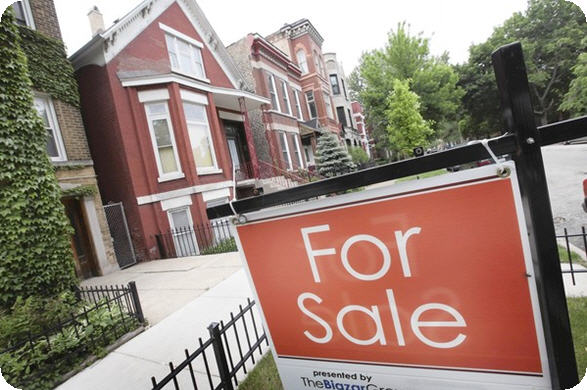
Homebuying: Should You Take The Plunge?

sale

Spring is typically the busiest season for homebuying, and this year the housing market is already showing signs of coming back to life.

According to the National Association of Realtors, the median price for U.S. homes was $173,600 in January, the latest month of available data. That’s up 12.5 percent from the same period in 2012, and is the largest year-over-year increase since 2005.

Have questions about the market?  Contact the appraisers at www.scappraisals.com

What’s more, even though home prices are beginning to rise, affordability continues to improve — especially for first-time buyers. The NAR’s first-time homebuyer affordability index reached a record high of 127.7 in 2012 (the higher the number, the better). In 2006, at the real-estate market’s peak, the index stood at 71.3.

Low mortgage rates and an improving economy are helping make homebuying more attractive today. Should you take the plunge? Consider the following.

Renting vs. owning

In many areas of the country, it is now cheaper to own a home than it is to rent. But much of that advantage still depends on the size of your down payment, the interest rate you’ll pay on a mortgage and the amount of time you plan to stay put.

Read more: http://www.chicagotribune.com/classified/realestate/buy/sc-cons-0321-started-20130323,0,5340581.story

Disclaimer: for information and entertainment purposes only
How Agents Read You

re agent

EVERY saleswoman will tell you that the customer is always transparent. Maybe not entirely, completely, but compared with the poker face a buyer thinks that he or she is wearing, there are always expressions and signals that are obvious to the practiced observer.

While every sale is different, there are also discernible stages that a customer goes through on the way to a transaction. A check with real estate brokers around the country indicates that many experienced ones “read the minds” of their customers — and can use their knowledge of consumer behavior to steer a market participant toward (or away from) a sale.

Want to know the value before you begin negotiating?  Contact the appraisers at www.scappraisals.com for value questions.

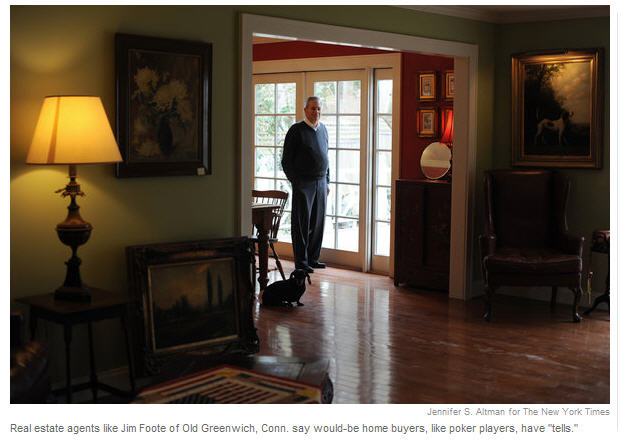
“Here’s a tell,” said Jim Foote, who has been in real estate for 38 years and is broker-owner of Greenwich Custom Real Estate Services in Old Greenwich, Conn. “If they linger for a long time in any one room, that’s telling you that there is something about this room that’s especially interesting to them.”

Conversely, a speed-through is often a sign of lack of interest. Mr. Foote has a current listing of a four-bedroom ranch house in Old Greenwich, on the market for $1.625 million. “If the progress from the hall through the living room, where the first fireplace is, through the dining room to the kitchen, through the family room where the second fireplace is — if that circuit takes two to three minutes, that’s pretty good,” Mr. Foote said. “If it takes 30 or 45 seconds, that’s not so good.”

Of course, agents who admit to “reading” their clients insist their pattern recognition is in service of the greater good. Even (or especially) in these days of consumer online access, some of an agent’s value lies in her being able to offer a buyer a choice different from his preconception.

Read more at: http://www.nytimes.com/2013/03/26/your-money/real-estate-agents-read-buyers-tell-tale-signs.html?ref=realestate&_r=0

Disclaimer: for information and entertainment purposes only