
How to Warm Your Home

1. Prune those sun-suckers

Shady plants are great in summer, especially on the north and western sides of your property. But at this time of the year you want to get as much sun into your house as you can. Now is the time to prune plants blocking out your sunlight, if possible.

2. Let the sun in

When the sun is shining, remember to open curtains and blinds during the day, especially on the northern side of your home, but also the east (in the morning) and the west (in the afternoon).

However, you might consider leaving south-facing blinds and curtains closed on days when it is colder outside than in as the sun won’t hit those windows.

It’s very common to see homes shut up all day long with the curtains drawn. But before you head off to work or out for the day, opening the blinds and curtains on windows that get the sun can mean coming home to a much warmer property.

Read more at: http://smh.domain.com.au/blogs/talking-property/how-to-warm-your-home-20120515-1ynv1.html

Disclaimer: for information and entertainment purposes only
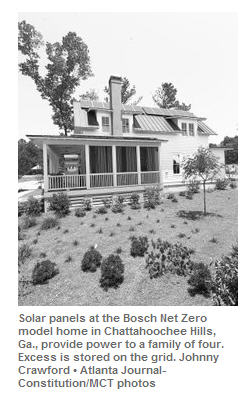
Georgia Home’s Yearly Energy Bill: $0

ATLANTA — In 2010, in the nippy environs of northeastern Canada, a family of six submitted to an experiment. Their task: spend one year living in one of the most energy-efficient homes built in North America. The house in New Brunswick looked like others except for the solar panels on the roof. But by year’s end, there was a more substantial difference — it was the only house on the block with a nonexistent energy bill.

Does this add value to your home?  More than likely; yes.  Contact the appraisers at www.scappraisals.com for your value questions.

“The house we built generated enough electricity for two families,” said Tom Black, vice president of Eco Plus Group USA, which partnered with Bosch to create the home.

Fast forward two years, and they have done it again, building the first Bosch Net Zero home in the United States at Serenbe in Chattahoochee Hills, Ga. The house, through the use of geothermal heat and solar voltaic panels, is designed to generate more electricity than it uses. The excess energy is stored on the distribution grid of GreyStone Power Corp., where it is redistributed as needed. At the end of the year, the series of energy credits and debits tracked by GreyStone should be at or near zero.

Read more at: http://www.utsandiego.com/news/2012/sep/08/tp-georgia-homes-yearly-energy-bill-0/

Disclaimer:for information and entertainment purposes only
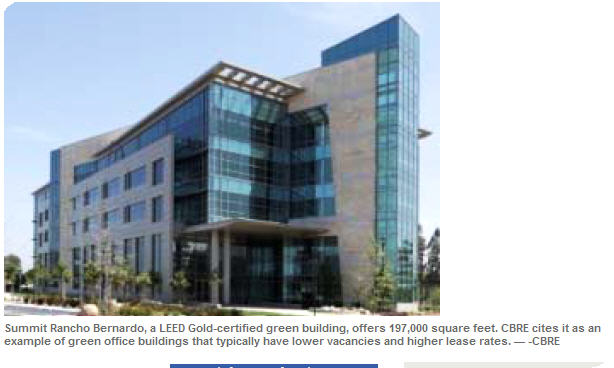
Green Buildings Outperformed in Vacancy, Rental Rates

Green” is better when it comes to lower vacancy rates and higher rents, according to the CBRE brokerage in San Diego.

CBRE looked at buildings with LEED certification or Energy Star ratings. LEED stands for Leadership in Energy and Environmental Design, a ratings program by the U.S. Green Building Council. Energy Star is a rating system by the U.S. Energy Department.

As of June 30, green buildings overall were 11.7 percent vacant compared with 15.7 percent of nongreen buildings.

The lease rates on average were $2.42 per square foot per month, compared with $2.04 for nongreen.

“Green buildings continue to outperform non-green buildings in the San Diego market,” CBRE said in its recently released MarketView quarterly report.

The gap is less for Class A and B buildings, those that charge the most rent and offer the best locations and amenities. Nongreen buildings in this category charge an average $2.24 per square foot. Virtually all green buildings are Class A or B, said CBRE Research Manager M. Lawrence Kopp

Read more at: http://www.utsandiego.com/news/2012/sep/05/green-buildings-outperform-vacancy-rental-rates/

Disclaimer: for information and entertainment purposes only