
San Diego Home Price Gains – Trail most of the nation

Home price gains in San Diego continued to slow in October compared to most of the nation, said the S&P CoreLogic Case-Shiller Indices released Wednesday.

Of the 20 regions covered in the index, San Diego metropolitan area’s increase, up 3.8 percent in a year, was the fourth smallest gain for the second month in a row. It was also below the national increase of 5.5 percent. The last time San Diego’s home price gains were around the same level was summer 2012.

Price gains for homes have slowed across the nation, down for the third month in a row. However, other California cities continue to outpace San Diego. Los Angeles metro area’s home prices were up 5.5 percent in a year and San Francisco was up 7.9 percent.

Most analysts attribute slowing home prices to rising mortgage rates, which greatly increase costs in pricey West Coast markets.

“Home price growth continues to outstrip wage increases and advancing mortgage rates combine for menacing headwinds that impact affordability,” wrote Cheryl Young, senior economist at Trulia. “The West remains hot, but even the hottest markets are cooling.”

The indices evaluate home prices by more than just price, tracking repeat sales of identical single-family houses as they turn over through the years. It is a favorite of economists, who use it to get a more complete view of the market instead of just the median home price.

In October, the median price for a single-family resale home in San Diego County was $610,000. Mortgage interest rates at the end of October were 4.97 percent, said Mortgage News Daily, meaning the monthly payment for a 30-year, fixed-rate mortgage (assuming 20 percent down) was around $2,610. But, interest rates were up 1 percent from the same time in 2017, increasing the monthly cost by roughly $289 in a year.

read more at: https://www.sandiegouniontribune.com/business/real-estate/sd-fi-case-shiller-down-20181226-story.html

Disclaimer: for information and entertainment purposes only
House tax bill contains gifts for homeowners – will it pass by end of year?

December is mega-tax-bill time on Capitol Hill, when legislation loaded with gifts and goodies for special-interest constituents moves ahead for action before the end of the year. House Republicans have unveiled their 2018 version — nearly 300 pages worth — and it has goodies galore: Write-offs and tax-credit deals for racehorse owners, “motor sports entertainment complexes,” TV and film producers, mine-rescue team trainers, two-wheeled electric vehicles, Indian coal facilities, economic development in American Samoa and a bunch of others. And yes, homeowners and builders are on the gift list as well:

• Did you pay mortgage-insurance premiums this year on a conventional home loan, a Federal Housing Administration (FHA)-backed mortgage or a Veterans (VA) loan? Congratulations! You’re a potential beneficiary if the bill passes.

• Did you install energy-conserving improvements in your house this year, such as high-performance windows, doors, roofing or skylights? Did you buy an energy-efficient furnace, hot-water heater or air conditioner? The new tax bill has a little something for you. Ditto if you built an energy-efficient new house.

• Were you underwater on your mortgage, forced to do a short sale, foreclosed upon or negotiated a loan workout agreement this year in which the lender forgave the balance owed? Good news. You’re covered by the bill — the IRS will not tax the forgiven balance of your debt as ordinary income if the bill passes and this tax-code provision is extended.

• Were you a victim of one the country’s recent natural disasters, such as hurricanes Florence or Michael, the Camp and Woolsey wildfires or the Kilauea volcanic eruption? The bill offers tax relief to assist your recovery.

The bill clearly has valuable provisions for certain groups of homeowners. But it also has fundamental problems. Start with the basics: Can it pass? One of the risks of sponsoring tax proposals late in a congressional session — House Ways and Means Committee Chairman Kevin Brady, a Texas Republican, only introduced it Nov. 26 — is that they can get squished in the last-minute crush of higher-profile legislation, such as this year’s federal-budget resolution. If issues like funding a southern border wall are not solved, there could be a government shutdown. Passing a tax bill in the middle of this brewing partisan storm is a serious challenge.

read more at: https://www.dailyherald.com/entlife/20181207/house-tax-bill-contains-early-holiday-gifts-for-homeowners

Disclaimer: for information and entertainment purposes only

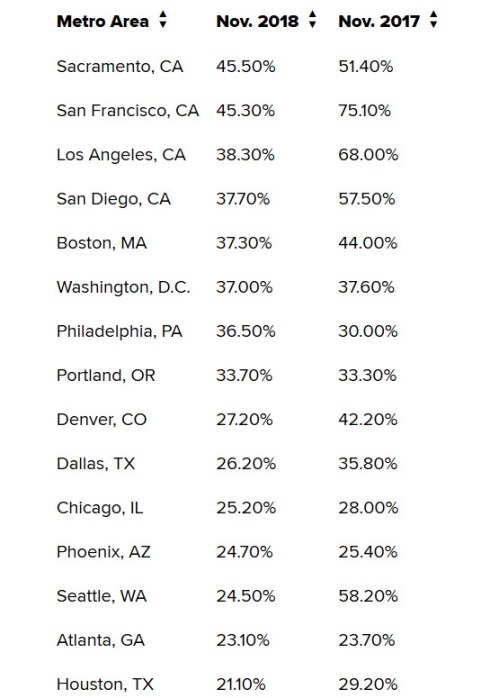
Some of the hottest housing markets are falling the hardest

housing


“Rising prices and mortgage rates have priced out some potential buyers while causing others to conclude that waiting to buy could pay off, especially as listings rise,” said Andrew LePage, a CoreLogic analyst. “For the past three months, sales have fallen year over year in all six counties and, in the last two months, across most major price categories including above $1 million.”

Mortgage rates rose sharply in September, and by October, the average rate on the 30-year fixed was more than a full percentage point higher than a year ago. With home prices already overheated in many major markets, higher rates broke the bank for most buyers.

Rates fell back again in November, but were still higher than a year ago. The drop did little to boost sales. Mortgage applications to buy a newly built home actually fell 11 percent year-over-year in November, according to the Mortgage Bankers Association, despite the rate relief.

And after one of the worst housing shortages in memory, supply is slowly starting to rise. Housing inventory in the large metropolitan markets Redfin tracks was up 5 percent in November annually, the largest supply boost in three years. Of course all real estate is local, and some markets are filling with listings faster than others.

Inventory jumped in formerly hot markets like San Jose (+123 percent), Seattle (+96.5 percent) and Oakland (+60 percent) but other markets are still seeing drops, like Philadelphia (-24 percent and New Orleans (-19 percent).

Read more at: https://www.cnbc.com/2018/12/14/some-of-the-hottest-housing-markets-are-falling-hardest.html

Disclaimer: for information and entertainment purposes only