Tag Archives: green home

Property Spotlight – Green GOOD Design Winner 2011

green house

They mean green

Here’s how the Krones home embraces green design principles:

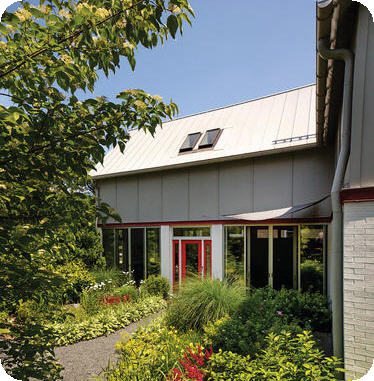
Optimizing use of the sun: Scott designed the home to incorporate passive and active solar strategies. Two courtyards are edged in Moduline sliding glass doors and floor-to-ceiling windows. They face south and west to capture light and heat, supplementing12 photovoltaic panels on the gabled garage roof that provide power to the house.

Make sure you get the value of your green upgrades in your next real estate appraisal; contact the appraisers at www.scappraisals.com.  They are the forerunners in green appraisals in Southern California.

Improving indoor air quality: Geothermal heating and cooling and an electronic air filter that removes allergens and pollutants provides economical environmental control; the garage is 37 feet away from the house to eliminate exhaust fumes; and the Krones used low-VOC materials throughout the house.

Using the land responsibly: “We choose a compact corner lot by East Wilmette standards, which is close to public transportation, schools, services and the beach,” says Scott. Scott maximized the home’s footprint with vaulted ceilings that drop to five feet on the edges of the second floor and soar to 23 feet in the center. “Village zoning doesn’t count any space lower than seven feet, so we effectively increased the size of the house by 20 percent,” he estimates. He also optimized the site by setting the long side of the house’s T-shape facing the house next door, fenestrating it with clerestory windows for privacy.

Creating a high-performance and moisture-resistant house: The house is built with engineered lumber, steel, common brick and fiber cement board, and the roof is standing seam aluminum — all materials that contribute to the strength, water resistance and reflectivity of the house. Coupled with high-density foam insulation and the heating and cooling system, “the house costs us very little in monthly expenses and is easy to maintain,” says Scott.

Wisely using the Earth’s natural resources: “We’ve very careful about what we bring into the house and how much we own,” says Sharon. “We’ve chosen our furnishings very carefully to last for a lifetime.”

Read entire article: http://www.chicagotribune.com/classified/realestate/home/ct-mag-0811-greener-gestures,0,3857817.story

Disclaimer: for information and entertainment purposes only
Green Home Could Result in a Larger Loan

solar

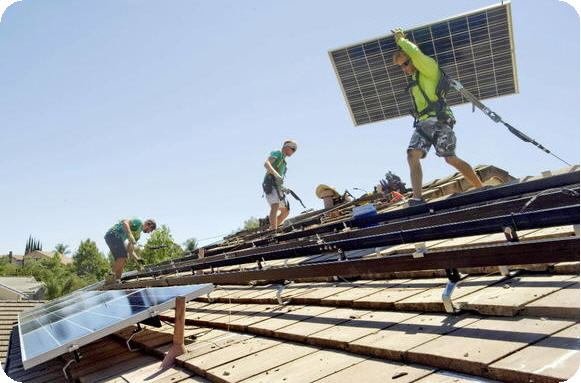
Those solar panels or radiant-heated stone floors could help snag a larger home loan under legislation now pending in the U.S. Senate.

The SAVE Act would require Fannie Mae, Freddie Mac and the Federal Housing Administration about 90 percent of the mortgage market to add energy efficiency to their underwriting policies.

Mortgage lenders and appraisers do not systematically consider the value of a home’s energy-efficient technology, said Robert Sahadi, director of energy efficiency finance policy at the Institute for Market Transformation, a nonprofit Washington D.C. group promoting green building. The organization co-authored the bill.

Have a green home or an energy-efficient home but did not get credit for it on the appraisal?  Contact the appraisers at www.scappraisals.com; we specialize in green and energy efficient properties.

“There have been some attempts in the past to do something about it, but they were premature, like 10 years ago, before consumers were really demanding these kinds of homes,” he said.

Sen. Michael Bennet, D-Colo., and Sen. Johnny Isakson, R-Ga., filed the bill in June. The bipartisan SAVE Act legislation has dozens of co-sponsors, and support from a broad variety of groups, including real estate agents, consumer organizations and environmental advocates. SAVE stands for Sensible Accounting to Value Energy.

While utility bills are ignored in mortgage underwriting, they usually amount to more money than real estate taxes or homeowner’s insurance, the institute says.

The typical U.S. homeowner pays $2,500 on home energy bills annually, according to the institute. The organization estimates an energy efficient upgrade, even a small one, could reduce a home’s energy bills by 30 percent or more.

The bill would help borrowers in two ways. Lenders would factor in energy cost savings when arriving at a borrower’s debt-to-income ratio, which could result in a larger loan. Lenders would add future energy savings to the home’s value, if that is not already reflected in the appraisal.

read more at: http://www.chicagotribune.com/classified/realestate/home/sns-mct-bc-real-solar-loan-20130730,0,7474472.story

Read more at: http://www.chicagotribune.com/classified/realestate/home/sns-mct-bc-real-solar-loan-20130730,0,7474472.story

Disclaimer: for information and entertainment purposes only.

Property Spotlight – ‘Active’ House Blends Old and New Style Engery Efficiency

active

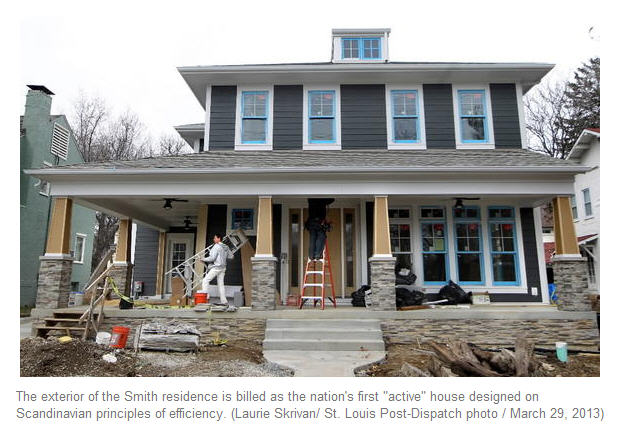
David and Thuy Smith’s new house at 215 Gray Avenue blends well with its neighbors, some more than a century old.

From its clapboard siding and stone-trimmed foundation to its wraparound porch with tapered Craftsman-style columns, the Smiths’ house appears at home, so to speak.

Is there value to making your home energy-efficient?  Contact the appraisers at www.scappraisals.com for your value questions.

But behind the old-time appearance is the latest in residential energy efficiency and low maintenance. Going green was the Smiths’ goal when they decided in 2011 to leave their 1940s bungalow in Brentwood.

What they are getting in Webster Groves is the first “active” house in North America, according to those involved in the project as well as specialty trade magazines.

“Active” construction combines energy efficiency, healthy indoor air and designs that take advantage of sun, shade and breezes. To compare, “active” house techniques are similar to those in LEED houses in the United States.

An open house is scheduled for today to give builders, real estate brokers and mortgage lenders a chance to inspect the Smiths’ innovative house. A public open house is set for Saturday.

The Smiths and their daughter, Cameron, 6, plan to move in next month.

In his design for the house, architect Jeff Day of St. Louis included numerous skylights to brighten the interior and, when open, to provide ventilation. The broad porch — something common before air-conditioning — shades first-floor rooms and protects part of the home’s fiber cement siding.

Read more at: http://www.chicagotribune.com/classified/realestate/home/sns-mct-active-house-blends-old–and-new-style-energy-20130308,0,7759441.story