#15 of the series

Insulate – Adequate insulation is crucial to saving energy. Get an energy audit so you will know exactly where you need to increase insulation.
Disclaimer: For information and entertainment purposes only.

#15 of the series
Insulate – Adequate insulation is crucial to saving energy. Get an energy audit so you will know exactly where you need to increase insulation.
Disclaimer: For information and entertainment purposes only.
Posted in energy savings
Tagged energy audit, heat camera, insulation, roof insulation
A Whole-House Home Energy Rating is a comprehensive evaluation of the efficiency of the entire home. The homeowner receives a written report that includes a numeric score or “rating” of the home, plus recommendations for improvements that will reduce energy bills and make the home more comfortable. Knowing the energy rating of your home is similar to knowing the miles per gallon rating of your car.

What kind of tests will they do in your home?:
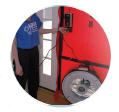 and the pressure test will show where the air is leaking out so you can “plug” the leaks and make your home less drafty. You want to keep heat and AC inside your home. Leaks let that conditioned air escape resulting in higher energy bills.
Read more about HERS rating at: http://www.energy.ca.gov/2009publications/CEC-400-2009-008/CEC-400-2009-008-BR-REV1.PDF
Will this add value to your home? Depends. If you have a HERS rating that can be presented to the appraiser that is one tool for the appraiser to determine value for your property being energy-efficient. The appraisers at Southern California Appraisal Services have been working with UCSD’s Environmental Engineering Department on ways to use a HERS rating to determine value of a property’s energy efficiency. If you have questions regarding value contact the appraisers at www.socalappraisalserv.com
Disclaimer: For Information and Entertainment Purposes.
Posted in energy retrofitting
Tagged blower door, energy efficiency, hers, hers rating, insulation
The answer to the questions again is it depends. Just remember that cost does not equal value. For example it may cost you $5 to make a pair of shoes but if you put Michael Jordan’s name on the shoes now the shoe is priced at $400 and people are paying $400 for the shoes so even though it cost $5 to make you can put them on the open market and people will pay $400.
First lets look at the cost effectiveness of adding insulation in terms of the “years to payback” for savings in heating costs. Years to payback is the time required for the insulation to save enough fuel from heating (at present prices) to pay for itself. A simple payback is the initial investment divided by annual savings after taxes.
The cost of the energy source is also a key factor in determining payback. Energy prices vary widely from region to region and season to season. Other factors, such as the rate of production and inventories of fuels nationwide, can also affect local energy prices. The weather from year to year also varies, so your energy costs from year to year will vary as well. Call your local utility for a rate schedule.
If you have your utility bills or you can call your utility and get copies, you can use this formula to figure out how many years to payback.
Years to Payback = (C(i) × R(1) × R(2) × E) ÷ (C(e) × [R(2) – R(1)] × HDD × 24)
To calculate the payback, you must supply the following information:
C(i) = Cost of insulation in $/square feet. Collect insulation cost information; include labor, equipment, and vapor barrier if needed.
C(e) = Cost of energy, expressed in $/Btu.
E = Efficiency of the heating system. For gas, propane, and fuel oil systems this is the Annual Fuel Utilization Efficiency or AFUE. Typical AFUE values are 0.6 to 0.88 for oil or propane furnaces, and 0.7 to 0.95 for natural gas furnaces. Older systems are usually less efficient. Use E = 1.00 for baseboard electric systems. For heat pumps, use the Coefficient of Performance or COP for E; where E = 2.1 to 2.5 for conventional heat pumps, and E = 3.2 to 3.5 for geothermal heat pumps.
R(1) = Initial R-value of section
R(2) = Final R-value of section
R(2) – R(1) = R-value of additional insulation being considered
HDD = Heating degree days/year. This information can usually be obtained from your local weather station, utility, or oil dealer.
24 = Multiplier used to convert heating degree days to heating hours (24 hours/day).
Here is an example:
Suppose that you want to know how many years it will take to recover the cost of installing additional insulation in your attic. You are planning to increase the level of insulation from R-19 (6-inch fiberglass batts with moisture barrier on the warm side) to R-30 by adding R-11 (3.5-inch unfaced fiberglass batts). You have a gas furnace with an AFUE of 0.88. You also pay $0.87/therm for natural gas. Let’s also suppose that you supply the following values for the variables in the formula.
C(i) = $0.18/square foot
C(e) = ($0.87/therm)÷(100,000 Btu/therm) = $0.0000087/Btu
E = 0.88
R(1) = 19
R(2) = 30
R(2) – R(1) = 11
HDD = 7000
By plugging the numbers into the formula, you obtain the years to payback:
Years to Payback = (C(i) × R(1) × R(2) × E) ÷ (C(e) × [R(2) – R(1)] × HDD × 24)
Years to Payback = (0.18 × 19 × 30 × 0.88) ÷ ($0.0000087 × 11 × 7000 × 24)
90.288 ÷ 16.077 = 5.62 years
What about value? An appraiser that specializes in green properties/energy efficiency can help you with it. Have copies of your utilities bills before and after installation to show appraiser and keep your documents from the insulation to show the appraiser. Some appraisers may not have the knowledge for green properties so you may want to contact an appraiser that specialize in energy efficiency.
The appraisers at www.socalappraisalserv.com can help you with value issues, they specialize in green properties and energy efficiency.
Disclaimer: Content for informational and Entertainment purposes only.

 Green Real Estate Appraiser