

Tag Archives: savings

Fall Deals for Home and Holiday

pumpkin

Bargain hunters, mark your calendars, start your engines and prepare to scope out sales that will give you a head start on gathering new loot for the household or gifts for the holiday season ahead.

Union Street Glass

Choose from a wide selection of pendants, ceiling and flush mounts, table lamps, wall sconces, and chandeliers – all handblown by artists recognized as leading creators of distinctive contemporary designs. There’s also a colorful array of locally made bowls, vases, platters and sculptural forms. These are prototypes, discontinued items, and one-of-a-kind glassware and lighting at 50 to 85 percent off retail.

Highlights: Pendant lighting $85-$150 (retail $300-$1,700); table lamps $125-$495 (retail $660-$715); lamp shades and finials $20-$60; sculptural vases, platters and bowls $45-$125 (retail $300-$1,200). Manhattan, Sienna and Savannah stemware is $42 (retail $95).

Details: 10 a.m.-4 p.m. Fridays-Sundays. Through Oct. 27. 833 S. 19th St., Richmond. (510) 367-1401 (day of sale only). www.unionstreetglass.com.

Highlights: Prices start at $20 for ornaments (retail $49), $20 for glass leaves and $95 for acorn paperweights (retail $195). Pumpkin paperweights start at $45. The 7-inch pumpkins are in the $100 range (normally $225); 14-inch pumpkins go for $250 to $600 (normally $1,200). Oversize apples, pears, peaches and strawberries will be $185 (retail $325). Extra markdowns will be posted on overruns, discontinued pieces and experimental one-of-a-kind gems.read more at: http://www.sfgate.com/homeandgarden/article/Fall-deals-for-home-and-holiday-4888882.php

disclaimer: for information and entertainment purposes only

Do Rebates Make Solar System a Wise Investment

solar

Erika Schweickert of Capital City Solar in Rocklin, Calif., has seen a surge the past couple of years in customers interested in investing in solar energy systems for their homes.

A solar energy system can significantly reduce — and in some cases eliminate — your monthly electric bills. Photovoltaic, or PV, solar systems work by converting sunlight that hits solar panels on the roof directly into electricity through an inverter attached to the house.

Does a solar system add value to your home?  Contact the appraisers at www.scappraisals.com    they are the forerunners in green property appraisals in Southern California.

“Some people do it to be green, but 90 percent of our customers are doing it because of the financial payback,” Schweickert said.

Kent Crook has spent 30 years working as an electrician as the owner of Wiremasters Electric Inc. in Miami, but for the past five years has built a business as Mr-Solar LLC. He’s sold on solar as a solution to our dependence on fossil fuels.

“It’s going to change the way we live,” Crook said. “We’ve got to do something with foreign fuel, with the carbon we put in the air. I feel solar is not the (only) solution, but it’s one of the solutions to help with these things.”

Solar systems have become much more affordable in recent years. Photovoltaic prices are determined by watts, with the national average about $3 a watt, nearly half of what it was in 2010. Add to that a 30 percent federal tax credit available for residential solar panel installation good through 2016, plus a variety of rebates and incentives offered from local utilities, and it makes the investment significantly less. Systems can range in price from a few thousand dollars to $50,000 before credits, incentives and rebates kick in, depending on the manufacturer and how many panels are installed.

“There’s not a better time than now to put it in,” Crook said.

In most states, home-owners with solar photovoltaic systems can sell back extra energy they don’t use to their local utility companies. In the arrangement, called “net metering,” customers earn credits for excess solar energy sent to the utility provider’s electrical grid from their house.

The number of panels homeowners need depends on their energy consumption and the amount of daylight the home receives. Ideally, panels should be installed on the south-facing side of the house.

If you’re thinking about adding a solar system, be sure to research the products and installers before you invest. One reason prices have fallen is because of a glut of manufacturers producing the products. Both Schweickert and Crook said quality of the panels can vary greatly, as can the quality of the installer.

Read more at: http://www.utsandiego.com/news/2013/jul/13/tp-energy-savings-rebates-make-solar-system-a/all/?print

Disclaimer: for information and entertainment purposes only
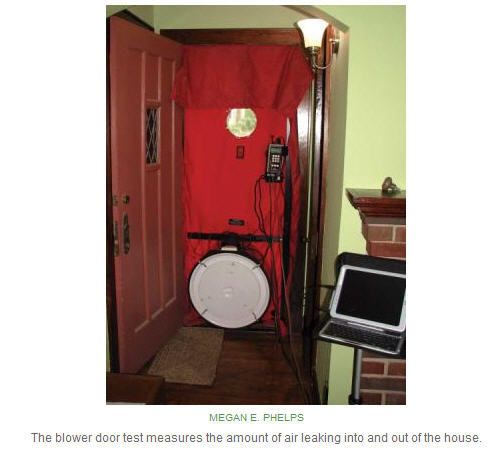
Home Energy Audit: Measure Your Energy Costs and Add Up the Savings

Conserving energy at home is a great idea for many reasons. It cuts down on energy costs, and because most of the energy we use comes from fossil fuels, using less is beneficial for the environment, too.

In many ways, saving energy can be pretty simple. You can find dozens of different ways to conserve — such as turning down your thermostat in the winter, putting a blanket on your water heater or switching to more efficient light bulbs. But most homes are so inefficient that even after you’ve done all the easy home improvements, there are still dozens of ways to save money and energy. How do you identify them all and then decide which to do first?

Read more: http://www.motherearthnews.com/green-homes/measure-your-energy-costs-zm0z11zphe.aspx#ixzz1fO7FxOA0

 
Disclaimer: For Information and Entertainment purposes only