 Cob building gets its name from the Old English term for “lump,” which refers to the lumps of clay-rich soil that were mixed with straw and then stomped into place to create monolithic earthen walls. Before coal and oil made transportation cheap, houses were built from whatever materials were close at hand. In places where timber was scarce, the building material most available was often the soil underfoot.
Today, building your own house is the exception to the norm, and it is almost unheard of to build with local materials. Instead, houses are built by specialists using expensive tools and expensive, highly refined materials extracted and transported long distances, often at great ecological cost. Industrial materials have many benefits — performance, predictability, speed and ease of installation — but they have in common that they must create a profit for the companies that manufacture them. The average number of members in U.S. households has dropped by more than half in the past 50 years. Yet, over the same time period, average home sizes have more than doubled. We are more comfortably housed than at any point in history, but practically enslaved by the payments (the word “mortgage” is French for “death contract”). Fortunately, we have other choices.
In the county where Ott lives, low-income housing is often a crumbling trailer home that is difficult to heat and cool and expensive to maintain. As she sits next to the woodstove in her cozy cob house, she explains that a quick fire in the morning warms the cob walls and will often keep the house warm for a day or more. She uses less than a cord of wood per year. Meanwhile, the same neighbors who laughed about her “dirt house” are stripping their own land of trees and burning trash just to keep from freezing. Some go through as many as 15 cords of wood per year. For less than what many people spend on a down payment, Ott has a house, and it performs well even by modern standards.
Cob’s thermal performance varies by climate region. While cob is a relatively poor insulator, it also has the ability to absorb large quantities of heat. These properties are valuable in regions such as the Southwest, but would be a disadvantage in the chilly Northeast, for example, where heat gains will quickly be lost. This weakness of cob can be solved by building interior walls of cob for mass heat storage while using better-insulating materials for exterior walls.
Anecdotal evidence and recent testing show cob walls are highly resistant to earthquakes. Unlike cement or adobe, which tend to shake apart in an earthquake, lumps of cob are woven together in the building process to form one large mass reinforced by straw fiber. Also, unlike cement, cob is easily repaired with the same material it was built from, and if torn down, there is no waste to be disposed of — only earth that can be returned to the ground or soaked in water and reused to build another room or house.
Oregon Cob-Building Method
Outside Coquille, Ore., stands a constantly evolving collection of test buildings affectionately known as “Cobville.” Sculpted cob garden walls weave around and between the tiny cottages, giving each its own sense of space. Here, apprentices and workshop attendees learn and experiment with ingredients, methods and finishes. This is the headquarters of the Cob Cottage Company, which is largely responsible for the re-emergence of cob building in the United States. Founded by Ianto Evans, his wife, Linda Smiley, and Michael G. Smith, Cob Cottage Company started with the radical idea that, with a little direction, almost anyone can learn how to build a cob house.
Evans, a spry Welshman now in his 70s, has reimagined the cob of his birthplace in a more efficient form. The traditional British cob method, which was generally to stomp lumps of whatever clay soil was handy into place, relied on thick walls for strength. “Oregon cob,” by contrast, effectively does more with less. Builders make thinner but significantly stronger walls by tightly controlling the clay-and-sand mix and using lots of straw for reinforcement. “We have created in Oregon cob an almost-free building material most people can manufacture for themselves. It has fluidity of form, and it’s healthy, non-polluting and local. The buildings it inspires are sculptural, snug and permanent,” Evans says. Because you can provide much of the construction labor yourself, cob is very affordable.
But Evans speaks of cob and “natural building” (a term he helped popularize) less in terms of cob-construction methods and more in terms of the social movement it has become. “Building your own house for less than $10,000 is revolutionary, and, yes, you can do it,” he says. “Millions of people in other countries and our own ancestors have proven that.” Evans has seen firsthand the way people are empowered by building their own houses from earth.
Cob-Building Community
Thirty years after its founding, Cob Cottage Company has much progress to report. Evans, Smiley and Smith’s book, The Hand-Sculpted House, has sold more than 30,000 copies worldwide. Their CobWeb newsletter documents 18 years of experiments and advances (and failures) in cob technology, and it is available at the Cob Cottage Company. Multiple nonprofits, such as the Natural Building Network, continue to promote cob building and work with code officials to streamline the approval process. Every year, natural builders host regional colloquia to swap techniques and foster camaraderie. Some travel hundreds of miles and sleep in tents to help each other with projects.
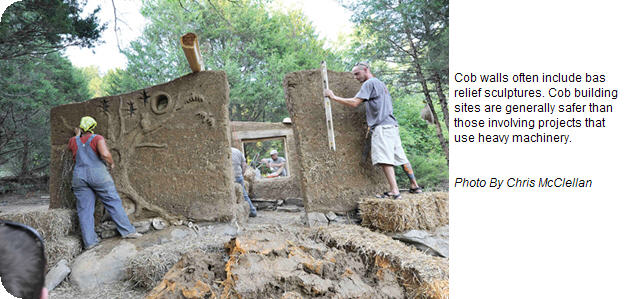
Cob Cottage Company alumni are building and teaching all over the world. Despite the downturn in the global economy — or maybe because of it — cob workshops are more popular than ever. On her first building project, Ott’s most steadfast supporter was an unemployed single mother who went on to build her own cob house after her first home was destroyed by a hurricane. Together, they built a building while chatting and watching kids run around the yard. A construction site is not a playground, but without the noise and danger of heavy machinery and without nails littering the ground, a cob-building site is a great deal more family-friendly. Most natural builders go to great lengths to keep that atmosphere on their job sites. Many times I’ve been grateful for that as I watched my young daughters hard at work atop the growing cob wall of a friend’s new bedroom.
If you are serious about building with cob, Evans strongly recommends that you seek hands-on experience, either at a workshop or by volunteering on a project. To find a workshop near you, visit the event calendars on the websites listed in the resources box to the left.
Cob Pros and Cons
Pros
• Uses local, generally inexpensive or free materials
• Can include creative, beautiful detail
• Nontoxic
• High thermal mass helps temperatures stay consistent and comfortable
• Negligible environmental impact
• Compatible with other natural materials (wood, stone, lime)
• Fun to build with friends
• Earthquake-resistant
Cons
• Labor-intensive
• Needs additional insulation in cold climates
• Will be unfamiliar to building code officials and insurers
Outlaw Building
Returning to basic shelter is a compelling idea, but in most of the United States, a complex combination of building codes, health codes, zoning codes, energy codes, deed restrictions and neighborhood covenants could indeed make you an “outlaw builder” if you decide to construct your own home. Ianto Evans refers to building and living in a low-cost, natural house as “a revolutionary act” and a challenge to “the greed of corporate commerce and the vigilance of its bodyguards, the governmental regulators.” I know people all over the country who are happily (and quietly) living in small cob houses with or without the approval of the local authorities, but knowing what you are getting into before you invest your time and money is important. Even a few thousand dollars (plus your time) is a lot to risk if there is a good chance a neighbor might object to your new dwelling. But the payoff of living cheaply in a house you love is substantial.
The permits for my last cob house were less than $1,000. Code compliance can be costly, however — more than $30,000 for permits in extreme jurisdictions. Perfectly safe alternatives to costly septic systems and wells exist, but they aren’t always legal. Minimum square footage requirements are often several times the size of what a person can afford to build without taking out a loan (which then gives the bank the final say on what you build). People have had their beautiful cottages torn down because they weren’t up to code. Others have built their small houses as “accessory buildings” or kept the footprint under 200 square feet to avoid code scrutiny. Finally, some builders have gone the extra mile to get tiny houses and natural materials approved or even added to the local code. Terry Herb’s recent e-book, No Building Codes, is an excellent starting point.
Your local city or county building department will be able to give you the best information, and the American Society for Testing and Materials has recently issued standards for building with earth.
DIY Cob Building Technique
We highly recommend you read at least one book on cob before you tackle a project. See the resources section below for our suggested reading. — MOTHER EARTH NEWS
Prepare the mixture. Cob is a mixture of approximately 1 part clay, 4 parts sand and 1 part straw. You can buy bagged clay in powdered form (go to Laguna Clay for local distributors) and masonry sand from your local supply store. However, most soil is a mixture of some part clay, some part sand and other materials, so you’ll save money if you use your own soil. If you are paying for soil, ask the supplier for your local variant of “compactable fill” or “road base.”
The “soil” we refer to is not the rich, black stuff in your garden or the top few inches of your lawn where everything grows. It is the subsoil below that, with little or no organic matter in it.
Build a foundation. Cob walls are heavier than those made of light timber. Before you build with cob, you will need a foundation that will keep your work up and away from damp ground and a roof that will keep it out of the rain. Natural builders call this having a good “hat and boots.”
Remove all vegetation and topsoil from your site, and mark out the perimeter of your cob construction with paint or pegs.
During rainy weather, water must move away quickly to keep cob dry. Dig a trench that will encircle the structure and lead water away. Backfill the trench with compacted gravel.
Stone or reclaimed concrete chunks (urbanite) make an excellent foundation. Lay your stones on tamped, solid ground within the gravel trench perimeter. You are finished when the foundation material feels absolutely solid beneath your feet.
Mix. Break up soil manually and soak it at least overnight in enough water to turn it into pudding. Pudding is a lot easier to mix with sand than clods of clay are.
The simplest way to mix cob is with your feet. (Music and friends make this a lot of fun.) Spread a 5-gallon bucket of sand on the center of your tarp, then a bucket of wet clay over that, then another bucket of sand.
Mix the sand and clay to form a pile, adding about two more 5-gallon buckets of sand as you mix. Sprinkle straw over your pile. Keep using the tarp to flip your pile, and mix it until the straw is distributed throughout the pile.
Break the mixture into balls — called “cobs” — of whatever size feels manageable, typically about the size of a softball. Make some test sections by molding some cobs together and letting them dry about one week to see how they hold up. You do not want a crumbly mix.
Build and sculpt. Place the wet cobs where desired and smash them into one another to form a single unit. If building a wall, place one cob for the outside face, one for the inside, and one for the middle. Meld together. Continue this process until you’ve formed your structure.
As you work, use your thumbs to knit the straw fibers from one cob lump into the cobs around it. Leave a rough surface for your next layer to stick to by covering the freshly laid cobs with thumb-sized holes, and wet the surface before applying new cob.
Everything you build is an excuse to get artistic. Improve a blank expanse of wall with a carved niche for a candle or special object. Sculpt an alligator or dragon bench to sit on. The steps are the same whether you’re making something big or small; it’s just a matter of scale.
Plaster. To finish the structure, apply plaster in at least two coats: a “brown” coat to even out imperfections, and a final coat, which can be polished or sealed with linseed or hemp oil. A standard lime plaster consists of 1 part lime putty, 3 parts sand and a quarter-part fiber.
Mix the plaster by foot or paddle in a bucket or trash can. Chop straw into tiny fibers using a weed trimmer inside a garbage can (wear eye protection and a dust mask). Cellulose insulation also makes a wonderful plaster fiber. Apply plaster to a slightly damp surface with a firm pushing motion. Plasters will often crack at the line where you stopped or started, so pick unobtrusive points for breaks. Seal plaster by painting it with several coats of linseed or hemp oil.
Maintain. Store leftover plaster in a sealed jar for repairs. Scratches can be rubbed out with rough sandpaper and re-oiled. Large cracks or breaks should be filled with reconstituted plaster, polished, and then oiled after they’ve dried.
Resources
Books
The Hand-Sculpted House by Ianto Evans, Linda Smiley and Michael G. Smith
The CobWeb Archive by Michael G. Smith and Ianto Evans
The Natural Building Companion by Jacob Racusin and Ace McArleton
Online
Natural Building Network
Cob Cottage Company
Barefoot Builder
The Natural Cottage Project
Natural Building & Green Homes With MOTHER EARTH NEWS



 Green Real Estate Appraiser