Category Archives: energy retrofitting

A Solar Panel Tupperware Party

Ever heard of Tupperware parties for solar energy? Neither had I—until last week, that is, when I received an invitation to attend one.

 For years, Lora Berg and her husband, Karim Chaibi, had been interested in the prospect of solar energy for her own house. But the upfront cost to install a system of panels on her roof, seemed prohibitive.

When the family returned to their Chevy Chase house last year after several overseas tours, they revisited the topic.

“It turned out we were lucky to come back at the perfect time to enter the market,” Berg said. “I had never thought I could actually do this.” After some research with the help of DC Sun, a coalition of solar neighborhood co-ops, she found several companies that offered lease-type arrangements in which no large investment from the homeowner is required—or even none at all. She invited two. Both provided her with proposals (see below) for monthly energy costs.

Read more at: http://www.washingtonpost.com/blogs/where-we-live/post/a-solar-panel-tupperware-party-too-good-to-be-true/2012/01/26/gIQAiJhITQ_blog.html

Disclaimer: for information and entertainment purposes only

Solar Installers Offer Deals, Gaining Converts

HOLMDEL, N.J. — Jay Nuzzi, a New Jersey state trooper, had put off installing solar panels on his home here for years, deterred by the $70,000 it could cost. Then on a trip to Home Depot, he stumbled across a booth for Roof Diagnostics, which offered him a solar system at a price he couldn’t refuse: free.

Contact the appraisers at www.scappraisals.com for you value questions regarding solar.

California: CA homeowners are increasingly choosing to avoid the upfront costs. In California, the country’s largest market, more than 70 percent of residential customers putting in solar this year have opted to sign a lease or power purchase agreement with someone else owning the systems, according to PV Solar Report.

The structure of the deals varies by company and state, but the overall approach is generally the same: Customers agree to pay a fixed monthly charge or rate for all the solar power produced, and the companies that finance the systems pay for the installation and take the value of any tax breaks or renewable energy credits for which the customer would ordinarily be eligible. Some companies concentrate on financing and use local contractors for sales and installation, while others do everything themselves.

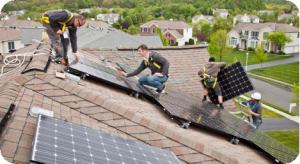
Story continued: Mr. Nuzzi had to sign a 20-year contract to buy electricity generated by the roof panels, which he would not own. But the rates were well below what he was paying to the local utility. “It’s no cost to the homeowner — how do you turn it down?” Mr. Nuzzi said on a recent overcast morning as a crew attached 41 shiny black modules to his roof. “It was a no-brainer.”

Similar deals are being struck with tens of thousands of homeowners and businesses across the country. Installers, often working through big-box chains like Home Depot or Lowe’s, are taking advantage of hefty tax breaks, creative financing techniques and a glut of cheap, Chinese-made panels to make solar power accessible to the mass market for the first time. The number of residential and commercial installations more than doubled over the last two years to 213,957, according to Greentech Media, a research firm.

http://www.nytimes.com/2012/05/10/business/energy-environment/solar-installers-offer-homeowners-deals-gaining-converts.html?_r=1&ref=realestate

Disclaimer: for information and entertainment purposes only

Study – Making Old Buildings Green has More Return Than New Green Buildings

The $350,000 study measures the effects of new construction compared with retrofitted buildings in four cities: Portland, Phoenix, Chicago and Atlanta.

It takes into account effects on the environment — for example, whether runoff from a building adds nutrients to a river, causing algae bloom and lower water quality — and whether a project uses nonrenewable resources like fossil fuels.

Contact the appraisers at www.scappraisals.com for your home value questions regarding updating your existing home.

The report also factors in the amount of additional energy that will be needed to extract resources like metal ores as they become more scarce.

The conclusion was that even the most energy-efficient new buildings have to stand as long as 80 years before their energy savings offset the negative environmental impacts of constructing them.

The report confirms a long-held belief of many in the green building/sustainability field, though it is the first piece of comprehensive research to back up the theory.

“In general, this study finds that building reuse almost always yields better results than new construction,” said Patrice Frey, director of sustainability at the National Trust for Historic Preservation.

Read more at: http://seattletimes.nwsource.com/html/businesstechnology/2018110139_oldgreen01.html

Disclaimer: for information and entertainment purposes only