Category Archives: Renewables and Energy

Solar powered clean drinking water

solar water

A solar-powered device that creates clean drinking water from the air is being trialled in Australia.

The portable Source Hydropanels, created by Zero Mass Water, are designed to suck moisture from the air, dehumidifying it to drain the water out before it purifies and add minerals to the water. It is powered solely by attached solar arrays.

Depending on the climate, the hydropanels can create up to five litres of potable water a day.

It is understood that the panels produce enough water to displace more than 20,000 plastic water bottles over its 15-year lifespan.

read more at: https://www.smh.com.au/environment/sustainability/solar-powered-clean-drinking-water-maker-trialled-20180427-p4zc4i.html

Disclaimer: for information and entertainment purposes only

Conserve water at home

water lau

Cape Town, South Africa, faced a scary scenario last month: The city of 4 million residents was warned by officials of an impending “Day Zero” when they’ll run out of fresh water. We know a bit here about what that feels like! The Cape Town date has been mercifully pushed back to late August — and may be averted by seasonal rains.

To help avoid a similar fate here, California building codes are regularly updated with rigorous conservation requirements. Even though we’re not in a drought at this moment, these tough rules help preserve our supplies for those inevitable times when we are.

Given the market power of California, our rules are spreading around the country. Take shower heads and tub faucets, for example: “July 1, 2018, California is mandating 1.8 gallons per minute,” says Steve Giandalia, The Home Depot’s regional merchandise manager for San Diego. By that date, he says, “We will be shipping 100 percent 1.8 GPM

Laundry conservation

“Washing laundry accounts for 15 to 40 percent of total home water usage,” says Home Depot’s Giandalia, but new rules and new technology have brought those numbers down, too. “Front-load and top-load impeller washing machines use significantly less per wash than top load agitator models (14 to 25 gallons versus 40 to 45 gallons).”

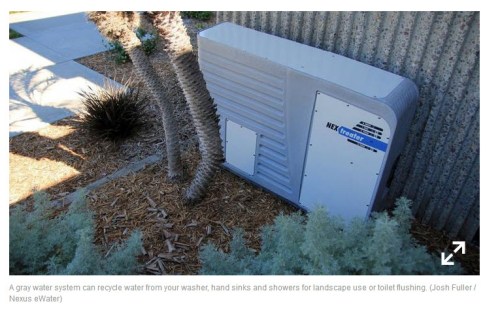
Another way your clothes washer — and bathroom sinks and showers — can help you conserve water is with a gray water system that recycles it for irrigating your plants and flushing your toilets. “There are three levels of gray water reuse in residential building in San Diego; the first is the simplest and it is for laundry water to be reused in landscaping irrigation. This does not require a permit, and the county has made a huge step in the right direction by making this easy to achieve,” says SDGBC’s Teare.

“It’s Encinitas code to have your home pre-plumbed for gray water, and many of our homeowners choose to install systems,” she says. “The downside of gray water is the long-term investment. The simpler systems can, however, be relatively inexpensive.” (You can also research whether rebate programs are available for your area.

read more at: http://www.sandiegouniontribune.com/lifestyle/home-and-garden/sd-hm-water-conservation-20180426-story.html

Disclaimer: for information and entertainment purposes only

San Diego – Time of use rates for solar give batteries a boost

What ‘time of use’ means

At the beginning of this month, San Diego Gas & Electric instituted new TOU rates.

Approved by the California Public Utilities Commission, TOU pricing fluctuates to encourage customers to run appliances and devices that consume a lot of energy — such as air conditioners and washer/dryers — when demands on the power grid are not as high.

For example, SDG&E offers residential solar customers a couple of TOU options, dividing the hours of the day into peak, off-peak and “super” off-peak time frames

Here’s the breakdown on weekdays:

  • On-peak: 4 p.m. to 9 p.m.
  • Off-peak: 6 a.m. to 4 p.m. and 9 p.m. to midnight
  • Super Off-peak: Midnight to 6 a.m.

And here’s the pricing that SDG&E offers households with a solar energy system during the summer months (June through October) when the grid often gets stressed from things like higher air conditioning usage:

  • On-peak: 54.2 cents per kilowatt hour
  • Off-peak: 27.9 cents per kilowatt hour
  • Super Off-peak: 21.9 cents per kilowatt hour

The price differential during winter months (November through May) is much less dramatic — just two cents per kilowatt hour separating On-peak and Super Off-peak.

But clearly, during the summer months, there’s a big financial incentive for customers to use power during off-peak and super off-peak hours.

What it means for solar customers

And that has an effect on the approximately 120,000 SDG&E customers with rooftop solar systems that produce electricity during the course of the day.

“In this new world order, when you use energy is as important as how much energy you use,” said Daniel Sullivan, CEO of Sullivan Solar Power.

read more at: http://www.sandiegouniontribune.com/business/energy-green/sd-fi-solar-batteries-20171219-story.html

disclaimer: for information and entertainment purposes only