
Category Archives: Uncategorized

Shopping Guide: Kitchen Island

island

If you don’t have a built-in island in your kitchen, don’t despair — you can buy a free-standing one or a worktable that serves the same function. A few things to consider:

• How much space do you have? “The rule of thumb is to have three feet on all sides of the island,” Mr. Berkus said. “But I’ve squeezed that down to 30 inches in certain locations.”

• How tall should it be? Islands are typically 36 inches high, standard countertop height. But depending on your personal preference, “anywhere from 30 to 38 inches is fair game,” said Mr. Berkus, who sometimes raises antique tables by adding casters.

 • Do you want it to match or contrast with the rest of the kitchen? “If you’ve got painted cabinetry but have always wanted wood,” Mr. Berkus said, “this is your moment to bring in something different.”
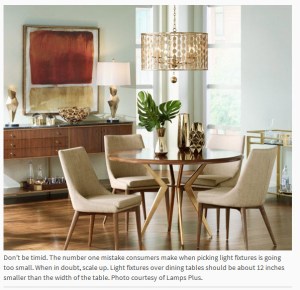
6 secrets to great lighting in your home

lighting

Secret No. 1: Light in Layers. In addition to natural light, every room should have three kinds of light, said Murphy: ambient, task and accent. Many homeowners throw a couple lights on the ceiling and call it enough. It’s not. Ambient light is your all-around light, and often comes from recessed cans or ceiling fixtures. Task lighting is dedicated to a space where you work or read; think of desk lamps, or lamps by reading areas, or under cabinet lighting over kitchen counters. Accent lighting highlights artwork, accessories or architectural features like the fireplace. The magic happens in the layering. “When these three layers work together with natural light, you have the perfect scenario,” he said.

Secret No. 2: Go big or don’t go. Choosing fixtures that are too small is the most common mistake homeowners make, said Murphy. “Most customers need to scale up.” For instance, when picking fixtures to go beside the front door, or to flank the garage, fixtures should be one third the height of the door. If the door is nine feet tall, the fixture should be three feet. When choosing a chandelier, use this formula: add the length and width of the room in feet, then convert to inches. That’s how big you want your fixture. So a 12-by-14-foot dining room should have a 26-inch wide chandelier. Ideally, this fixture is also about 12 inches narrower than the width of the table, and allows at least four feet of clearance from walls.

read more at: http://www.denverpost.com/2016/07/16/jameson-in-the-dark-about-light-six-secrets-to-great-lighting-in-your-home/

Residential Solar Power Buying Guides – Get the best deal

Thanks to professional resources like the Solar Energy Industries Association (SEIA), evaluating your solar power needs and understanding the best type of solutions for your home has never been easier. SEIA has made available several consumer guides to solar power that make it simpler for homeowners to properly evaluate offers (its best to get a number solar power quotes) and fully comprehend your agreement terms.

SEIA’s most recent residential consumer guide to solar power outlines several key areas:

Evaluate your home:  Think about your personal electricity usage and how it’s used in your home. You should take a look at your utility bill and how much kilowatt-hours (kWh) your household uses and how much you’re currently paying for it. This will help determine the number of panels and output you will need from the system.    The BPI appraisers at www.scappraisals.com recommend a HERS rating before you start shopping for solar panels.  The more energy efficient your home is before you start shopping for panels will in all likelihood decrease the number of panels you will need.

You should also check out your roof and get at solar professional come out for an evaluation. They will be able to provide a consolation and calculate the amount of sunlight you’re currently getting and if its enough.

read more at: http://www.motherearthnews.com/renewable-energy/residential-solar-power-buying-guides-zbcz1606.aspx

disclaimer: for information and entertainment purposes only