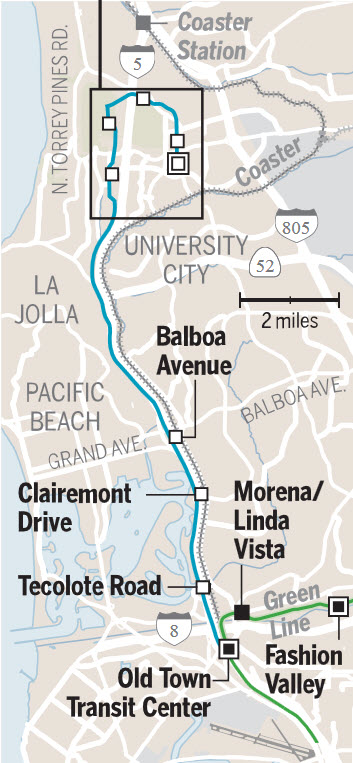
San Diego – Mid coast trolley gets funding; completion date 2021

How will it effect neighborhood home prices?  Contact the appraisers at http://www.scappraisals.com for your home value questions.

trolly

The extended Blue Line is expected to serve riders in Mission Beach, Pacific Beach, the Veterans Administration Medical Center, UC San Diego, University City and other areas. An anticipated 20,000 people are expected to ride per day, many of which don’t have trolley lines in their suburban neighborhoods. Trains are expected to arrive every 15 minutes in both directions when the line opens for service in five years, and every 7½ minutes shortly thereafter.

read more at: http://www.sandiegouniontribune.com/news/sd-me-trolley-funding-20160913-story.html

disclaimer: for information and entertainment purposes only

 

San Diego – Better fire protection may lower insurance rates

organization that weighs fire risks has determined that San Diego’s backcountry is safer after years of investments, a declaration that may make it possible for property owners in the county’s rural stretches to buy fire insurance for the first time or to pay lower premiums on existing policies.

The improved rating from the Insurance Service Office came after the Board of Supervisors created the San Diego County Fire Authority in 2008 and spent hundreds of millions of dollars to improve fire protection in 1.5 million acres of the backcountry after major fires in 2003 and 2007.

The county put various fire agencies under one command, and added more career firefighters, staffing, equipment, training and communication systems. The investments cut response times by 30%, the county said.

The fire protection and the improved rating is a big deal for people who live in rural parts of the county, according to Supervisor Dianne Jacob.

“What this means is not only can they get fire insurance, it lowers the cost of fire insurance in much of this area,” she said.

The $350 million worth of improved rural fire protection is also important for people who live in more populated areas, she added.

read more at: http://www.latimes.com/local/lanow/la-me-san-diego-wildfire-risk-20160909-snap-story.html

disclaimer: for information and entertainment purposes only
Don’t be frozen out of the mortgage market: New programs can help

Are you or someone you know needlessly missing in action this summer, leaving near-historically-low mortgage money at 3 1/2 percent to 3 3/4 percent on the table? You might be if you fit this profile:

•You’re renting, though your goal is to buy a home. But you assume you can’t qualify for a mortgage because today’s underwriting rules are so strict and inflexible.

•You don’t have a lot of extra cash in the bank and you seriously doubt that you could scrape enough money together to afford a down payment.

•Your credit scores aren’t great — just under 700 FICO — but that’s mainly because you’re young and don’t have a deep credit history.

Sound just a little familiar? Well, here’s some good news. Giant mortgage investor Fannie Mae last week revised and improved its low down payment mortgage plan known as HomeReady. Fannie’s competitor, Freddie Mac, has a similar program known as Home Possible Advantage. Either one could be key to your getting out of your rental apartment and buying a house or condo by early fall.

Check out the basics of Fannie’s program. Start with the 3 percent down payment. There’s no minimum cash contribution requirement out of your wallet as long as you’re buying a single family house to live in. You can supplement your cash on hand with gifts from relatives or other sources. You can also increase your effective income for mortgage qualification purposes by including so-called “boarder” or in-house rental payments. Say the rowhouse you want to buy downtown has a long-term tenant in a basement unit who would like to remain in the house. That rent could count toward your income.

Another flexibility: Say you’re part of an extended family and you expect to have other household members living in the house with you who earn incomes but don’t want to be on the mortgage note as a co-borrower. You can use their documented earnings to increase the maximum debt-to-income ratio (DTI) you’re allowed on your mortgage.

read more at: http://www.chicagotribune.com/classified/realestate/ct-re-0807-kenneth-harney-column-20160803-story.html

disclaimer: for information and entertainment purposes only