
Residential Solar Power Buying Guides – Get the best deal

Thanks to professional resources like the Solar Energy Industries Association (SEIA), evaluating your solar power needs and understanding the best type of solutions for your home has never been easier. SEIA has made available several consumer guides to solar power that make it simpler for homeowners to properly evaluate offers (its best to get a number solar power quotes) and fully comprehend your agreement terms.

SEIA’s most recent residential consumer guide to solar power outlines several key areas:

Evaluate your home:  Think about your personal electricity usage and how it’s used in your home. You should take a look at your utility bill and how much kilowatt-hours (kWh) your household uses and how much you’re currently paying for it. This will help determine the number of panels and output you will need from the system.    The BPI appraisers at www.scappraisals.com recommend a HERS rating before you start shopping for solar panels.  The more energy efficient your home is before you start shopping for panels will in all likelihood decrease the number of panels you will need.

You should also check out your roof and get at solar professional come out for an evaluation. They will be able to provide a consolation and calculate the amount of sunlight you’re currently getting and if its enough.

read more at: http://www.motherearthnews.com/renewable-energy/residential-solar-power-buying-guides-zbcz1606.aspx

disclaimer: for information and entertainment purposes only
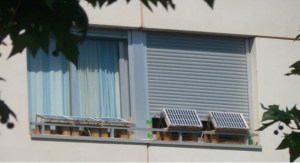
 

How to get your Condo or apartment off the grid

solar apt

Solar panels have become cheaper and more efficient in recent years, but they are far from a universal solution, even in sunny regions. One reason is that a typical solar photovoltaic (PV) installation is still beyond the budget of many people. The average pricing for a 5kW residential PV system completed in 2014 varied from $11,000 in Germany to $16,450 in the USA. [1, 2] Roughly half of that amount concerns the installation costs. [3]

A second obstacle for solar power is that not everybody lives in a single-family dwelling with access to a private roof. Those who reside in apartment buildings have little chance of harvesting solar power with a conventional roof-mounted system. Furthermore, in apartment buildings, the roof would quickly become too crowded to cover the electricity use of all residents, a problem that grows larger the more floors there are in a building. Lastly, a typical solar installation is problematic when you’re renting a place, whether it’s a house or an apartment.

These conditions allow me to get through the winter without a heating system, relying only on solar heat and thermal underclothing. Hot water is supplied by a solar boiler, which was installed by the landlord. Clothes are dried on the balcony. While tinkering with solar panels for an art project, I got an idea: with the sun already powering so much of my living space, wouldn’t it also be possible to harvest solar power from the window sills and the balcony and take my apartment off the electricity grid? Such a PV installation would solve my problems:

  • I don’t need access to the roof.
  • I can install the system myself, which makes it much cheaper.
  • I can take the solar installation with me if I move to another place.

Obviously, the big question is whether or not such an unconventional solar system could generate the necessary electricity. As a first experiment, I decided to power my 10 m2 home office with solar panels placed on the 2.8 m long window ledge that runs along the windows of the office and the adjacent bedroom.

read more at: http://www.lowtechmagazine.com/2016/05/how-to-go-off-grid-in-your-apartment.html

disclaimer: for information and entertainment purposes only

 

Modern house held together by double-sided tape

tape

This house may be held together with double-sided tape, but it’s anything from crumbling.

The aptly named ‘Double Stick’ house by Studio Pali Fekete Architects is new and, according to the firm, is the first to be built using industrial-strength tape.

Not only is it structurally sound but it’s also been lauded for its architecture, taking out first prize in the Housing category at this year’s Los Angeles Business Council Architecture Awards.

read more at: http://www.domain.com.au/news/modern-house-held-together-by-doublesided-tape-20160704-gpu9u6/