
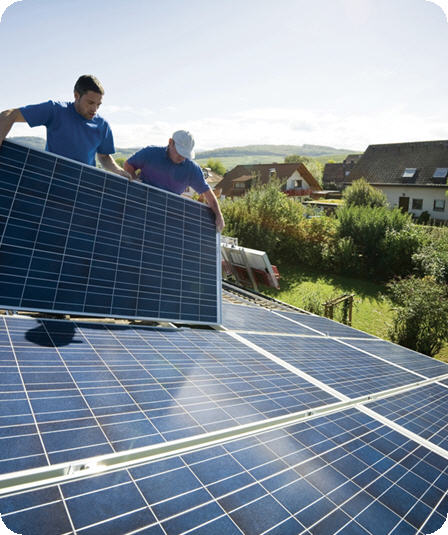
Solar Power Costs Continue to Fall

solar

Lower prices. Solar panels are a sizeable investment, but according to a recent report from the Solar Energy Industries Association, the average national price for a solar electric system is now less than $5 per watt installed. That’s a notable drop since 2009, when prices averaged $8 per watt. Ten years before that, they were about $12 per watt. A small home solar electric system might be 2 kilowatts (kw) — or 2,000 watts. At $12 per watt, the system would have cost $24,000. At $5 per watt, it’s more like $10,000.

Does solar add value to your home?  Contact the appraisers at www.scappraisals.com they are the forerunners in green and energy-efficient real estate appraisal.


Federal incentive. You can receive a large federal tax credit for purchasing a home solar electric system. This tax credit — which is available through 2016 — is 30 percent of the price of the system, with no upper limit. So for that same 2-kw, $10,000 system, the cost would now be down to $7,000. (For more information, visit Energy Star.)

Read more: http://www.motherearthnews.com/renewable-energy/home-solar-power-zmgz13onzsto.aspx#ixzz2g10dOcC0
Cool Thing – Charge Your Phone By Walking, Running

charge

Charging your mobile phone battery may soon be little more than a walk in the park.


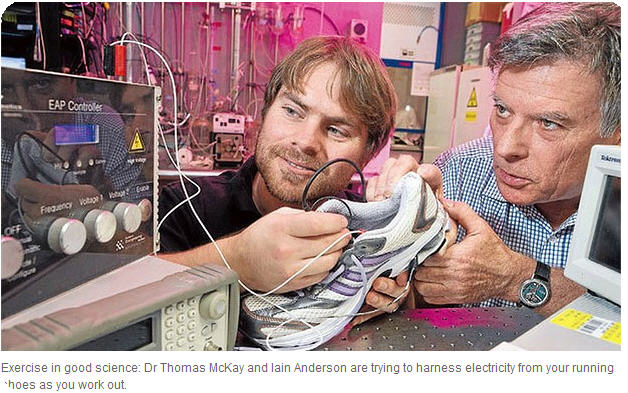
The Auckland Bioengineering Institute’s Biomimetics lab has built electric generators that can harness the energy of movements such as running and walking, which they hope will soon be able to power personal devices.


“When you walk, you flex your legs and strike your heel on the ground, and you swing your arms. The rubbery heel is used to buffer the impact with the ground. Imagine if you could take that buffering, that energy-absorbing bit, and use that in a positive way,” said associate professor Iain Anderson, head of the Biomimetics lab.


A normal shoe dissipates energy as heat when it hits the ground. This technology uses thin stretchable generators to turn mechanical energy into electrical energy.


The idea, originally from US research institute SRI International, has been developed by the Kiwis into smaller, lightweight generators to allow for more comfortable, practical energy generation.


“Before we started doing what we are doing you had to have quite a big high voltage power supply and complicated switches. We have eliminated that big bulky stuff so you can put it into a shoe,” said Dr Thomas McKay, who worked alongside Anderson in the Biomimetics lab.

They hope to be able to convert the technology to real, practical uses within the year, using the energy of movement to charge smartphones, iPods and heart rate monitors for athletes.


“We are moving into a world where we have all these extra capabilities and wearable systems – we’ll need some way of powering these wearable systems,” said Anderson.

Read more: http://www.smh.com.au/digital-life/mobiles/charge-your-smartphone-by-walking-running-20131001-2upis.html#ixzz2gTgG9UeZ

San Diego – Home Prices, Sales Slip In August

San Diego County home prices and sales slipped from July to August as the market took a breather from recent increases, DataQuick reported Thursday.

The median price last month was $415,000, down from $417,500 in July but still up 20.2 percent from year-ago levels.

Sales also were lower, down 9.5 percent from July to 4,099 transactions, a common seasonal dip. Total sales are up 3 percent from August 2012.

Has the value dipped in your neighborhood?  In some neighborhoods in San Diego value can differ from the county statistics.  Contact the appraisers at www.scappraisals.com for your home value or your real estate appraisal needs.

DataQuick President John Walsh said the trends, generally consistent across the six-county Southern California region, reflect fewer all-cash and investor buyers, still-tight inventory and rising mortgage rates.

“There’s something for everyone in today’s housing data,” Walsh said in a statement. “Sellers have seen an amazing price jump from just a year ago, allowing many to finally sell at a profit.”

Freddie Mac’s weekly primary mortgage market survey, also released Thursday, showed the 30-year, fixed-rate loan unchanged at 4.57 percent from last week, not counting origination fees. The most recent low was 3.4 percent in April.

“As we head into fall and winter, a slower time of year,” Walsh said, “we’ll probably see year-over-year price gains continue to taper.”

Michael Lea, a real estate professor at San Diego State University, said he was not surprised by the price dip but was “a little puzzled” that sales are not rising as fast as they should at this point in the economic cycle. “I would have thought sales would be picking up,” he said.

Read more at: http://www.utsandiego.com/news/2013/sep/13/tp-home-prices-sales-slip-in-august/