
Green Remodeling: Make Your Home More Energy Efficient

Imagine you live in your green dream home. It’s extremely energy-efficient, but also beautiful, comfortable and perfectly suited to your needs. Are you picturing a brand new house? Think again — you can likely turn your current house into your dream home with smart green remodeling.

Will energy efficiency add value to your home?  Contact the appraisers at www.scappraisals.com for your value questions.


Plus, the amount of money you can save with energy upgrades is often more than you might think. Russ Rudy, a builder and energy-efficiency expert who has done numerous gut rehabs of homes in the Midwest, says he helps homeowners get energy savings of up to 75 percent when he’s able to rework a house from top to bottom. Even with less intensive work, significantly cheaper energy bills are possible. The nonprofit organization Historic Green, based in Kansas City, Mo., has been doing a series of energy retrofits in one of the city’s neighborhoods. The organization reports it has been able to cut some homes’ energy use in half, resulting in an average cost savings of $100 per month on energy bills.


ee

Those are substantial energy savings, but why stop there? If you’re doing a major home overhaul, you can go one step further and add passive solar design features to optimize your home’s natural heating, cooling and daylighting. And you can just as easily add renewable energy features — such as solar electric panels or a solar water heater — to an old home as you can to a new one. Many green remodeling projects can be done on a tight budget — you just have to start thinking through what’s possible.

Read more: http://www.motherearthnews.com/green-homes/green-remodeling-zm0z13jjzsor.aspx?newsletter=1&utm_content=05.24.13+GEGH&utm_campaign=2013+GEGH&utm_source=iPost&utm_medium=email#ixzz2UK0ylJW5

Disclaimer: for information and entertainment purposes only.
Greater Efficiency for Solar Panels

solar

One thing a solar panel shouldn’t do is reflect the sun — for every photon that bounces off is one less electron of electricity the panel will create.

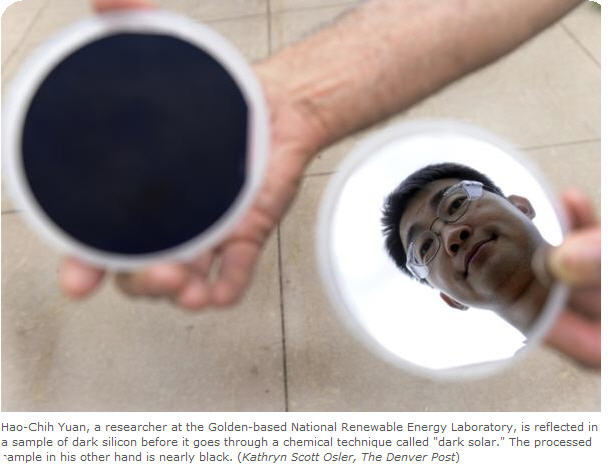
How to make that panel less shiny? Researchers at the Golden-based National Renewable Energy Laboratory have come up with a solution: peppering a cell with trillions of tiny holes.

The technique dubbed “dark solar” has been licensed to Red Bank, N.J.-based Natcore Technology Inc., which is combining it with its own low-cost solar-cell-manufacturing process.

Does solar add value to your home? or did you not credit  for having solar on your home on your last appraisal?  Contact the appraisers at www.scappraisals.com

“It’s a perfect coupling of technologies,” said Natcore CEO Chuck Provini.

American solar-panel makers have been under pressure as prices dropped more than 50 percent in the past five years because of a flood of inexpensive Chinese solar panels.

The question is whether American manufacturers can come up with a technological counterpunch, Provini said.

A flat silicon surface without any treatment will reflect 35 percent of the sunlight that hits it, said Hao-Chih Yuan, an NREL researcher.

That’s why solar manufacturers coat the panels using an expensive and toxic gas-deposition system.

Even with that, about 7 percent of the light still bounces off a poly-silicon cell.

Read more: NREL pursues greater efficiency for solar panels – The Denver Post http://www.denverpost.com/breakingnews/ci_23317867/nrel-pursues-greater-efficiency-solar-panels#ixzz2UJz0v8Do

Disclaimer: for information and entertainment purposes only.
Tightly Sealed Homes Are Coming Our Way – Passive, Yet Powerful Houses

passive

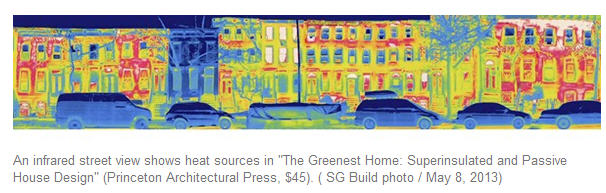
The idea of passive house design isn’t new. It was first promoted in the early 1990s.

But the concept — virtually airtight buildings, heavily insulated and using triple-glazed windows, requiring little energy for heating or cooling — has yet to capture the public’s imagination. Part of the problem may be people’s lack of exposure to a passive house. There just aren’t that many to visit.

Does this add value to your home?  Contact the appraisers at www.scappraisals.com for your value questions.

“Unless you can show the public the projects under construction, then stand in it when it’s finished, I think it’s hard to understand the passive house,” says Julie Torres Moskovitz, the founding principal at Fabrica718, an award-winning Brooklyn design firm.

Torres Moskovitz estimates there may be 40,000 certified passive house buildings in the world, but probably fewer than 50 projects in the United States.

“There are also a lot of houses being built with the passive house (concept) in mind that don’t quite reach the (certification) level,” she says.

The stringent passive house — or Passivhaus — standards and the Passive House Planning Package software were developed by the Passive House Institute in Germany. The U.S.-based Passive House Institute is currently formulating its own standards. The PHPP software incorporates a designer’s calculations and helps design a passive house.

A passive house saves up to 90 percent of space heating costs and 75 percent of overall energy costs, though some European studies indicate the numbers may be even higher.

read more at:http://www.chicagotribune.com/classified/realestate/home/sc-home-0513-passive-house-20130518,0,1741726.story

Disclaimer: for information and entertainment purposes only