
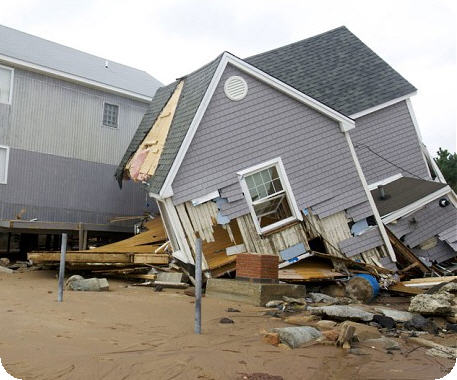
Post Diasaster Tips for When it is Time to Rebuild

So you think you’ve had contractor nightmares. I know I have.

But I guarantee you that ours wither like flowers by the fire compared to what Linda Lipofsky’s been through.

Lipofsky’s home saga involves an act of God, a nefarious contractor, a bankrupt insurance company and lost hope, all followed by absolute good. It’s a tale that will destroy your faith in humanity, then restore it, and teach everyone a lesson.

The story begins in August 2004 when Hurricanes Charley, Frances and Jeanine blew through the Southeast, leaving behind billions of dollars in destruction. The gales destroyed the Orlando home where textbook editor Lipofsky — now a retired 66-year-old — had lived for 20 years, and which she had paid off years earlier.

Shortly after the hurricanes, Lipofsky, like millions of others, tried to find a contractor to repair her roof, which had partially blown off and was leaking badly.

Read more: Post-disaster tips to keep with your disaster survival kit – The Denver Post http://www.denverpost.com/athome/ci_21917334/post-disaster-tips-keep-your-disaster-survival-kit#ixzz2BGykVpTt

Disclaimer: for information and entertainment purposes only

The Pay-as-You Go Remodel

SOMETIMES not having enough money to renovate right away can be a blessing in disguise.

At least that’s how Nina Johnson-Milewski, an art dealer and the owner of Gallery Diet, and her husband, Dan Milewski, an artist who owns a cafe and wine bar, have come to regard it.

In 2006, they bought a 1939 bungalow here for $230,000, but they couldn’t afford to make the changes they envisioned before moving in. So they spent the next six years living in the one-story house while they gradually renovated it, putting in thousands of hours of their own labor, as well as $75,000 — in bits and pieces, whenever they could.

The advantages of slow renovation quickly became obvious. “You only see what you need once you’re living in the space,” said Ms. Johnson-Milewski, 27. That’s when “you see how you want the house to function.”

So it was first by necessity, and later by choice, that the couple, who met in 2004 as students at the School of the Museum of Fine Arts in Boston, let the design of their 2,100-square-foot house evolve room by room and chair by chair.

read more at: http://www.nytimes.com/2012/11/08/greathomesanddestinations/in-miami-a-pay-as-you-go-remodel.html?ref=realestate&_r=0

Disclaimer: for information and entertainment purposes only

Learn House’s Cutoff Switches Before an Emergency Stikes

Controls and monitors for heating, cooling, power and other systems are crammed into cluttered dashboards in cars. In houses, they’re spread all over, sometimes in plain sight, often tucked away where you wouldn’t expect them or have a clue what they regulate.

There are dozens of kill switches and cutoff valves, but no map showing where they are and no manual explaining what they control and how to use them. That’s a problem in the dark, in a flood or other emergency when you need to isolate a problem in the house. Is this the right handle, the right valve? Turn it left or right, push it up or down? Pop the breaker, but which one?

Mains. Power comes into the service panel to doubled breakers, called the mains. They feed power to the rows of breakers below. Normally, if a single breaker trips, the mains stay engaged and power still flows to most of the home. Tripping the mains cuts off power everywhere.

Circuits. Each one has a breaker. It may protect several outlets or one high-use appliance like an electric stove. Labeling breakers so you know what they control ought to be part of every installation. But you may have to make your own labels. Otherwise, to check a minor problem at one outlet, you have to trip the mains. You can use circuit-tracing tools (check sperryinstruments.com) to discover what each breaker controls. In renovated homes it may be an illogical hodgepodge. Or you can take the tedious route, work with a partner room by room, turn everything on, then trip one breaker at a time to see what goes off.

Read more at:http://www.chicagotribune.com/classified/realestate/home/sc-home-diy-home-control-20121101,0,2457008.story

Disclaimer: for information and entertainment purposes only