
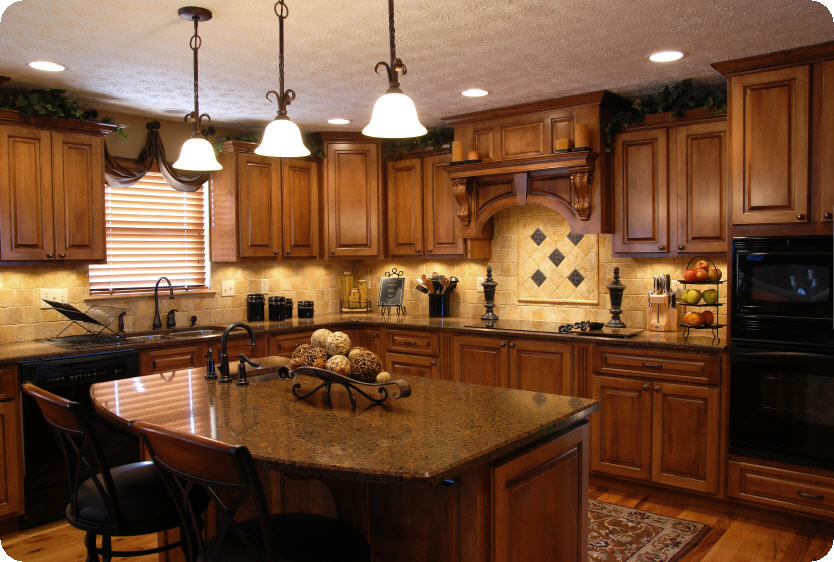
Depressed Home Prices Fuel Spike in Remodeling

Do you fit any of these descriptions?

• You came through the housing bust and recession far more debt-averse than you were before.

• You’ve been reluctant to consider selling your house because you don’t believe you’ll get what it’s really worth.

• Buying a new home is out of the question, even with today’s low interest rates, because it’s so difficult to qualify for a mortgage.

• You’ve gradually come to the conclusion that it’s smarter to improve the house you already own — spend some money on making it more comfortable, more up to date — and just stay put for a while.

Contact the appraisers at www.socalappraisalserv.com for your remodeling value questions.

Whether you share them or not, sentiments like these are having profound effects on real estate markets across the country, fueling post-recession interest in remodeling. In fact, according to federal estimates, by late last year the annualized dollar value of expenditures on renovations outstripped expenditures on newly constructed single-family homes — a huge change from pre-recession years, when the ratio was sometimes 3-to-1 in favor of new construction.

Underscoring this trend: In late January, the National Association of Home Builders’ remodeling market index hit its highest level in five years. It’s not that remodeling is moving into boom territory, said David Crowe, chief economist of the association, but rather that for many consumers, fixing up their house now fits their sentiments — and their finances — far better than selling or buying.

Interviews with builders and remodelers in different parts of the country point to important changes in homeowner strategies. In Seattle, Joe McKinstry, president of Joseph McKinstry Construction Co., says inquiries about possible remodeling projects have nearly tripled in the past 12 months.

“I feel like people are starting to say, ‘Well, we’re not going to move anytime soon because, if we do, we’re going to get 30 percent less than the house is worth. Why don’t we do something in the kitchen or bathroom for our own enjoyment?’ ”

Read more: http://www.utsandiego.com/news/2012/feb/05/tp-depressed-home-prices-fuel-spike-in-remodeling/

Disclaimer: For information and entertainment purposes only

Thinking of Buying a Foreclosure? Try the Foreclosure Cost Calculator

Homebuilders are switching tactics and confronting head-on one of their biggest nemeses: foreclosed houses that not only lure buyers away with deeply discounted prices but simultaneously depress the appraisal values of newly built homes.

At a packed session at the International Builders’ Show expo in Orlando Feb. 8-11, consultants and builders said that with gluts of foreclosures in major markets around the country — and more forecast to arrive in the next two years — the time has come to stop being passive and to begin aggressively educating buyers about the often hidden costs of buying foreclosures.
In Phoenix, one large builder, Fulton Homes, has put together the equivalent of an online truth squad — an interactive “foreclosure cost calculator” that allows shoppers to estimate the expenses they’re likely to encounter if they opt for a foreclosure.  The calculator uses what the company’s vice president, Dennis Webb, said are commercially available expense averages for acquiring, repairing and outfitting foreclosed houses of varying sizes, conditions and price levels in the area.

Say you’re shopping for a home to live in, rather than to rent out as an investment. You locate a number of foreclosures at low listing prices. You’re also aware of newly constructed homes that appear to carry higher prices for similar lot sizes and square footage.

The cost calculator prompts you to input the size, price and physical condition of the foreclosures. Say one of them is listed for $110,000 with 2,125 square feet of living space. Based on a drive-by, you estimate the overall condition to be fair — not terrible, but not great either. For that foreclosure, according to Fulton’s data, the typical post-acquisition costs — the repairs, new equipment, appliances and other improvements to make it adequate for you and your family — would add another $32,288 to the price you pay.

Likely expenses include an estimated $1,063 in appliances, $2,125 in electrical upgrades, $3,613 in windows, $5,525 for flooring and carpeting, $5,695 for cabinets, $1,913 in plumbing, $1,488 for drywall, $1,399 for the roof, $683 for interior cleaning, and a long list of others. The calculator also identifies possible legal fees, such as $1,500 in eviction costs if the property is still occupied, plus lawyers’ bills for title and lien complications.
Next to the calculator — here comes the big sell — Fulton offers you a look at some of its own newly built homes that are in the same general price range. They come with none of these add-on costs and instead have extended warranties on construction, appliances and equipment plus independent third-party inspections. Webb said in an interview that the calculator has been “amazingly effective” in opening the eyes of home shoppers to the “dark side” of foreclosures, and has helped the company rack up rising sales in a market where 46 percent of local listings are foreclosures.

Read more here: http://www.miamiherald.com/2012/02/19/v-print/2646677/the-dark-side-of-buying-a-foreclosure.html#storylink=cpy

Calculator: http://www.fultonhomes.com/foreclosure-calculator

Disclaimer: for information and entertainment purposes only

Solar Project Faces Problem

BLYTHE (AP) — A major Southern California solar energy project could be delayed or even canceled following a deadly outbreak of distemper among kit foxes and the discovery of a prehistoric human settlement on the work site, according to a report Saturday.

The $1 billion Genesis Solar Energy Project near Blythe in the desert east of Los Angeles was on track to start producing power for some 187,500 homes starting in 2014.

But critics tell the Los Angeles Times (http://lat.ms/wrtgOD ) the distemper outbreak and discovery of a possible Native American cremation site show that expedited procedures approved by state and federal regulators failed to protect wildlife and irreplaceable cultural resources. They say the problems could probably have been avoided by more rigorous research and planning.

The 250-megwatt plant was backed by an $825 million Department of Energy loan guarantee. Genesis had hoped to be among the first of a dozen approved solar farms to start operating in Southern California.

An official with Florida-based NextEra Energy Resources, the builder of Genesis, told the Times the problems threaten the entire project. If too many acres are deemed off-limits to construction, “the project could become uneconomical,” said Michael O’Sullivan, a NextEra senior vice president.

Native Americans, including the leaders of a nearby reservation, and environmentalists are trying to have Genesis delayed or even scuttled.

Read more: http://www.sgvtribune.com/california/ci_19951439

Disclaimer: for information and entertainment purposes only