
Tag Archives: home solar

New Solar Tool: Google can tell if a home should convert to solar

Google has a new tool that can determine if your house should convert to solar power.

The search giant’s recently released Project Sunroof wants to map the amount of sunlight a rooftop receives to help decide if it makes financial sense to go solar.

By typing the home’s address into Project Sunroof, users can find out how much space there is for solar panels on the roof, how many hours of rooftop sunlight it would get a year and how much power bills could be cut by.

Project Sunroof comes under the $US2 billion ($2.8 billion) that Google is funding for renewable energy projects.

How it works

Upon typing in the address a Google Earth image of the home appears with the roof a colour ranging from yellow to purple, indicating how much sunlight hits the surface.

To determine this colour rating the program analyses the amount of solar radiation in the area surrounding the roof and 3D modelling of the roof.

It then adjusts for factors such as cloud and temperature patterns and shade from nearby buildings and trees.

Project Sunroof will also recommend the size of solar system that you should install based on your average electricity bill.

The final step in the process is Project Sunroof’s ability to put you in touch with a local solar panel company that will install the system for you.

One Forbes journalist has pointed out that Project Sunroof’s site doesn’t mention that solar companies will pay Google a hefty referral fee to anyone sending business their way.

So far the American cities San Francisco, Fresno and Boston are the only searchable ones.

read more at: http://www.domain.com.au/news/google-can-tell-if-a-home-should-convert-to-solar-energy-20150826-gj6bur/
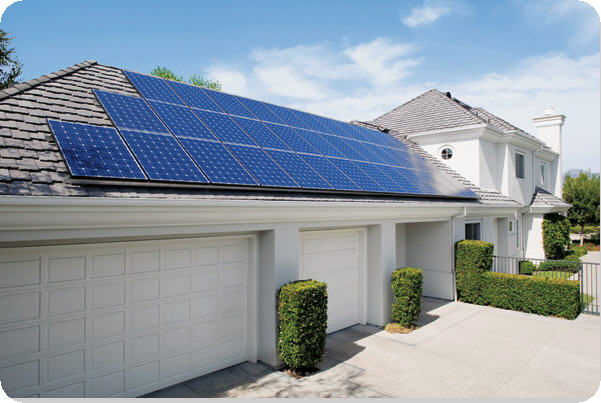
Thinking of Leasing a Solar PV System for your Home?

Data from the California Solar Initiative (CSI) program, the largest and longest-running residential and commercial solar incentive program in the United States, show that third-party-owned residential installations grew rapidly as the solar industry created and refined the third-party ownership model. In 2012 and 2013, more than two-thirds of residential installations in the CSI program were third-party owned. Industry reports have indicated that the growth in popularity of third-party-owned residential solar PV systems is occurring in other states as well.

Will a leased PV solar system add value to your home?  Contact the appraisers at www.scappraisals.com for your value questions.  They are the forerunners in green property appraisals.

How the Third-Party Ownership Model Works


Homeowners can contract with a company—sometimes called a solar leasing company, solar finance company, or third-party ownership company—to have a solar PV system installed on their rooftop (or elsewhere on their property). Depending on the agreement, the solar leasing company will often be responsible for financing, permitting, designing, installing, and maintaining the PV system. The contract between the homeowner and solar leasing company is typically structured in one of two ways:


  1. PPA option: the homeowner buys all of the electricity produced by the solar PV system at an agreed-upon price (or set of prices) through what is known as a power purchase agreement (PPA). The PPA prices are usually lower than or competitive with the homeowner’s local electric utility rate. PPAs are usually longer-term contracts with terms of up to 20 years.
  2. Lease option: the homeowner makes pre-established monthly payments to the solar leasing company. The payment amount is not tied to the PV system’s actual output, but it is calculated to be competitive with the homeowner’s existing electric bill.


Both of these contract options will usually offer a buyout option at the end of the contract term or during certain points over the contract period that would allow the homeowner to purchase and own the PV system.

Benefits:  The homeowner:


  • Can install a PV system without paying large upfront costs or expending time and effort to knowledgeably purchase and arrange installation of the system.
  • Will not have to operate or maintain the PV system if these responsibilities are included in the service agreement.
  • Can lock in long-term costs for electricity, which could be a major benefit if the homeowner expects electricity prices to rise in the future.

Challenges and Limitations


  • The homeowner may pay for the convenience of having someone else build and maintain the system by having to share some of the available incentives with the solar leasing company, although this may be offset by the convenience of the arrangement and the potential reduced cost structure offered by the solar leasing company.
  • The third-party ownership option is not consistently available throughout the country. According to the Database of State Incentives for Renewables & Efficiency (DSIRE), third-party solar PV PPAs are currently allowed or in use in all or portions of at least 22 states and the District of Columbia.

read more at: http://www.homeenergy.org/show/blog/id/519/nav/blog

Disclaimer: for information and entertainment purposes only


Is Going Solar an Investment?

solar

San Diego County is the hottest solar power market in the nation right now, with about 1,000 homes lighting up new systems each month.

Based on my hard-nosed analysis, solar is a fair-to-good investment for most homeowners who pay $175 or more each month on just the electricity portion of their bill from San Diego Gas & Electric Co.

Want to know if adds value to your home?  Contact the real estate appraisers at www.scappraisals.com ; they have the only qualified “green” appraisers in Southern California.

Definition of “good” is a return on my solar investment within shouting distance of 10 percent, given that cash pays a paltry 0.1 percent in a money market.

Like any investment, there are risks. In the case of home solar, the greatest risk is that state or federal policymakers will eventually reduce the financial incentives.

Of course, there are compelling environmental and national-security benefits that go beyond the risk-return trade-offs.

Once installed, solar provides decades of pollution-free power. Moreover, if you drive an electric car, you can take comfort that you’re not buying oil from anti-U.S. regimes.

read more at: http://www.utsandiego.com/news/2013/oct/17/is-going-solar-an-investment/

Disclaimer: for information and entertainment purposes only