
Tag Archives: real estate appraisal

Risks, Rewards of Buying Foreclosures

It’s hard to look at the rock-bottom prices for foreclosures and short sales in the Chicago area and not feel you could get a great deal.

Contact the appraisers at www.scappraisals.com for foreclosure value questions.

After all, homes that are going for 50 percent off might seem like a once-in-a-lifetime opportunity. But buying troubled properties is a frustrating, time-consuming process, filled with hassles and potential risks.

“You buy a short sale or foreclosure as is. No warranties. That can be a problem,” said Steve Hovany, a housing analyst and president of Strategy Planning Associates in Schaumburg.

“Foreclosed properties often are handyman’s specials. Many of them have been vacant for months or years and require major repairs. Not only that, but some previous owners may not have been nice to the house that ruined their life.”

Sara Benson of Chicago-based Benson Stanley Realty, added: “Some angry owners with foreclosed homes put concrete down drains. The house may be literally destroyed. The buyer may get just a shell and the land.”

Read more at: http://www.chicagotribune.com/classified/realestate/foreclosure/ct-mre-0610-foreclosures-20120607,0,6252097.story

Disclaimer: for information and entertainment purposes only
It Pays to be Proactive in a Short Sale

Under new guidelines set down by Fannie Mae and Freddie Mac, underwater borrowers who are seeking to sell their homes for less than what they owe must now receive decisions from their lenders within 60 business days. But if they are not careful, floundering borrowers can cause delays beyond the two-month deadline.

Contact the appraisers at www.scappraisals.com for short sale values.

The new rules, which took effect June 15, apply only to loans owned or rolled into securities by Fannie and Freddie. But because the two mortgage giants are the main conduits between primary lenders and investors in mortgages, their precepts cut a wide swath.

More than 10 million homeowners are said to be underwater with their mortgages. Not all want to get out. Many are content with their current situations and have no intention of moving, at least for now. Others continue to hold on in hopes that values will start rising again.

Unfortunately, others need to go, and many of them would rather sell at a loss through a short sale — a loss their lenders would have to absorb — than have their homes taken away.

The new 60-day rule became necessary because lenders were taking an inordinate amount of time to make up their minds — eight months on average at one point, according to RealtyTrac, a foreclosure data firm. It took so long to receive an answer that many would-be buyers became tired of waiting for a decision and went elsewhere.

But borrowers need to realize that the rules cut both ways. While lenders are required to adhere to faster timelines, borrowers also must do their part. Otherwise, they can short-circuit their own short sale.

A decision can be delayed, for example, if all the paperwork the lender requires has not been supplied. If something as simple as a photocopy of a driver’s license is missing, a borrower might have to start the process over, says Steven Horne of Wingspan Portfolio Advisors, a firm that services nonperforming loans.

Consequently, Horne and others agree that the most important thing a borrower can do is engage the services of a real estate professional or attorney who has experience in short sales, preferably with their particular lender. Not to bash rookies, but now is not the time to allow someone to cut his or her teeth on a deal.

Read more at: http://www.chicagotribune.com/classified/realestate/foreclosure/sc-cons-0621-short-sales-20120622,0,2460153.story

Disclaimer: for information and entertainment purposes only

Adding on to Your House Expands Your Options Too

Homeowners needing more room are in a tough spot these days. They want to trade up, but sell now in a depressed market and they lose money. One alternative is expanding the place you already have — adding on instead of leaving and taking the loss.

Contact the appraisers at www.scappraisals.com for your value questions.

It might be a two-story wing of extra beds and baths, or a simple bump-out that opens up a cramped kitchen. Whatever the scope, you won’t have to go house hunting or pay thousands in closing costs and real estate commissions, transaction fees that could buy concrete and wallboard for an addition. It may take a while for housing to recover. But when it does (it always has) the investment will pay off.

To start, check plan books or shelter magazines or come up with your own sketches. Try different versions, the ultimate space versus the practical space. When you get one or two that work, the question becomes how to make them part of the house.

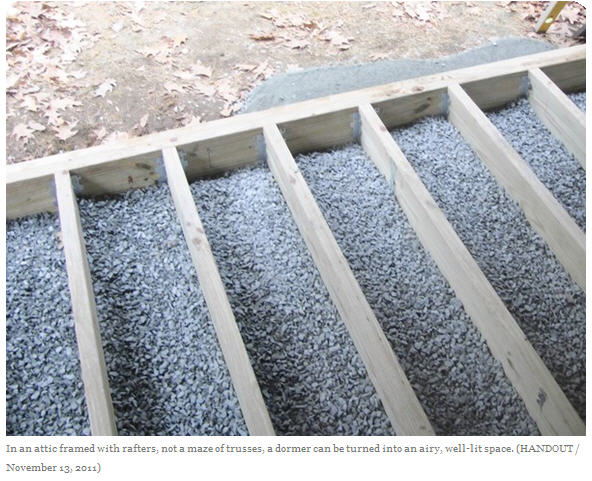
Expanding up In homes with an attic that’s framed with rafters, not a maze of trusses, dormers can turn dead space into airy, well-lit living space. Framing in an attic can be tough, particularly when new 2-by-4s join existing timbers that are a little cockeyed. On the other hand, you don’t need to excavate, pour a footing, or build a foundation. The only intrusion into living space below is a stairway. Pull-down attic stairs won’t cut it. The only major framing job (in most homes) is to beef up the floor joists. Extra strength is needed because loads in unfinished attics are usually figured to be lighter than loads in finished spaces with people and furniture. Where you’ll find 2-by-10 joists on the first floor, the attic is likely to have 2-by-6s. Expanding even more and raising a full second story on a one-story house is more difficult. Loads are the problem because the existing structure down to the footings is designed to carry what’s there, not almost twice as much.

Read more at: http://www.chicagotribune.com/classified/realestate/home/sc-home-0618-diy-plan-expansion-20120623,0,7980127.story

Disclaimer: for information and enterainment purposes only