
Tag Archives: solar panels

Greater Efficiency for Solar Panels

solar

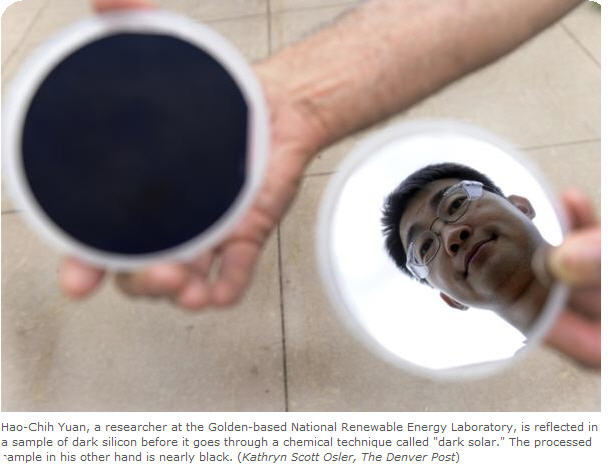
One thing a solar panel shouldn’t do is reflect the sun — for every photon that bounces off is one less electron of electricity the panel will create.

How to make that panel less shiny? Researchers at the Golden-based National Renewable Energy Laboratory have come up with a solution: peppering a cell with trillions of tiny holes.

The technique dubbed “dark solar” has been licensed to Red Bank, N.J.-based Natcore Technology Inc., which is combining it with its own low-cost solar-cell-manufacturing process.

Does solar add value to your home? or did you not credit  for having solar on your home on your last appraisal?  Contact the appraisers at www.scappraisals.com

“It’s a perfect coupling of technologies,” said Natcore CEO Chuck Provini.

American solar-panel makers have been under pressure as prices dropped more than 50 percent in the past five years because of a flood of inexpensive Chinese solar panels.

The question is whether American manufacturers can come up with a technological counterpunch, Provini said.

A flat silicon surface without any treatment will reflect 35 percent of the sunlight that hits it, said Hao-Chih Yuan, an NREL researcher.

That’s why solar manufacturers coat the panels using an expensive and toxic gas-deposition system.

Even with that, about 7 percent of the light still bounces off a poly-silicon cell.

Read more: NREL pursues greater efficiency for solar panels – The Denver Post http://www.denverpost.com/breakingnews/ci_23317867/nrel-pursues-greater-efficiency-solar-panels#ixzz2UJz0v8Do
Disclaimer: for information and entertainment purposes only.

How to Warm Your Home

1. Prune those sun-suckers

Shady plants are great in summer, especially on the north and western sides of your property. But at this time of the year you want to get as much sun into your house as you can. Now is the time to prune plants blocking out your sunlight, if possible.

2. Let the sun in

When the sun is shining, remember to open curtains and blinds during the day, especially on the northern side of your home, but also the east (in the morning) and the west (in the afternoon).

However, you might consider leaving south-facing blinds and curtains closed on days when it is colder outside than in as the sun won’t hit those windows.

It’s very common to see homes shut up all day long with the curtains drawn. But before you head off to work or out for the day, opening the blinds and curtains on windows that get the sun can mean coming home to a much warmer property.

Read more at: http://smh.domain.com.au/blogs/talking-property/how-to-warm-your-home-20120515-1ynv1.html

Disclaimer: for information and entertainment purposes only

Assessing Whether Solar Panels Make Sense for You

As  reported in The Times, legions of companies will offer to install a system at no upfront cost and promise customers cheaper, cleaner electricity over the course of 20 years. Some are small and local, while others, including SolarCity, Sunrun, Sungevity and SunEdison, are larger, with national or even international reach. Some large manufacturers, like SolarWorld, even offer financing plans for home installations.

Contact the appraisers at www.scappraisals.com for your solar value questions.

For residential customers, the deals can seem attractive. The company arranging the financing for the system usually owns and operates it, selling the electricity back at a rate generally lower than what the utility would charge. Depending on the company and the state, the details vary. In some cases a customer pays a preset rate for the electricity used, known as a power purchase agreement. In others, the customer leases a system, paying a set monthly charge for a guaranteed amount of power.

Part of the appeal here is that customers can not only reduce their energy costs but fix them for a long period of time, avoiding the unwelcome surprise of a suddenly high bill because, say, natural gas prices have shot up again. Customers also avoid having to figure out how to claim the various incentives and benefits for which they qualify as a renewable energy producer.

But there are some things to look out for. Going solar does not mean going off the grid. A typical roof array will not handle all of a home’s electricity needs since it produces power intermittently. So customers will still get a bill from the utility, though probably a much smaller one. Many contracts also have escalator clauses, with the payments increasing over time, so it is important to determine if your energy costs are likely to go up or down if you were to stick solely with the utility.

Read more at: http://green.blogs.nytimes.com/2012/05/09/how-to-assess-whether-solar-panels-make-sense-for-you/#more-140266

Disclaimer: for information and entertainment purposes only