

Why understanding home energy performance will become a key to real estate success

agent

Real estate professionals play a pivotal role in the U.S. residential real estate market. Overseeing from start to finish the multiple steps and piles of paperwork involved with property transactions, they support both sellers moving forward with the next stage of their lives and buyers looking for a new place to call home. They provide trusted and influential guidance that affects the largest investment that most of us will ever make: our homes.

Home energy performance is too often overlooked by buyers and sellers during property transactions, and buyers seldom have easy access to energy performance information. Even though U.S. homeowners spend on average about $2,200 per year on energy bills and increasingly indicate demand for energy-efficient homes, real estate professionals generally undersell (or are unaware of) the benefits of homes with strong energy performance. These benefits include improved comfort, health, privacy, programmability, and interconnectivity, as well as increased monthly affordability and—where relevant information is made available—resale value. Moreover, U.S. real estate listings generally lack details about a property’s energy performance, energy-efficient features, and estimated utility costs. This omission contributes to the unnecessary perpetuation of the invisibility of home energy upgrade investments, housing dissatisfaction, underinvestment in home energy upgrades, plateauing residential energy savings, and risks to U.S. real estate market stability.

Opportunity is calling for all real estate professionals to tap into the promising U.S home energy upgrades market by helping clients understand, prioritize, and invest in home energy performance during the property transaction process—when buyers and sellers already tend to make general home improvements. Real estate professionals who enhance their home energy performance capabilities can lead their competitors on market trends and improve the long-term prospects of their business.

read more at: http://zeroenergyproject.org/2017/04/14/sold-understanding-home-energy-performance-will-become-key-real-estate-success/

disclaimer: for information and entertainment purposes only
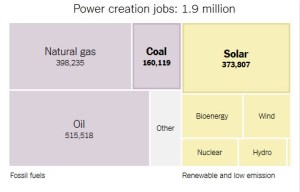
There are more than 2 jobs in solar for every 1 job in coal

solar

Those numbers come from a Department of Energy report published in January by the Obama administration that provides the most complete picture available of American energy employment.

In 2016, 1.9 million Americans were employed in electric power generation, mining and other fuel extraction activities, according to the report – a field we’ll call power creation for short.

More than 373,000 Americans worked part or full time in solar energy, and just over 260,000 of them – or about 70 percent – spent a majority of their time on solar projects.

Most solar energy jobs were in installation, construction and manufacturing, as the relatively new industry continued to add capacity. Solar power still generated a small share of United States energy output last year.

The coal industry, which has shed jobs since 2012, primarily due to competition from cheap natural gas, employed just over 160,000 workers nationwide. About 54,000 coal jobs were in mining.

It’s important to note that power creation isn’t the only source of energy employment. The Energy Department report found another 2.3 million jobs in energy transmission, storage and distribution, a number that includes powerline and pipeline workers and more than 900,000 retail jobs, such as gas station workers and fuel dealers. If non-traditional energy workers are included in the mix – those involved in manufacturing and installing energy-efficient products – the total number of energy-related jobs swells to 6.4 million.

read more at: https://www.nytimes.com/interactive/2017/04/25/climate/todays-energy-jobs-are-in-solar-not-coal.html?hp&action=click&pgtype=Homepage&clickSource=story-heading&module=photo-spot-region&region=top-news&WT.nav=top-news

Disclaimer: for information and entertainment purposes only


San Diego #1 for Solar

After finishing second behind Los Angeles for three consecutive years, San Diego came in first place in the nation as the city with the most installed solar power.

Solar power increased 60 percent in San Diego in 2016, reaching 303 megawatts of installed photo-voltaic capacity, finishing 36 megawatts ahead of Los Angeles and almost 60 percent higher than Honolulu and San Jose, which finished third and fourth.

In the previous report, San Diego racked up enough installed capacity to power 47,000 homes. In the latest rankings, released Tuesday, the number grew to nearly 76,000 homes

Read more at: http://www.sandiegouniontribune.com/business/energy-green/sd-fi-solar-report-20170403-story.html