
San Diego Water Use Restrictions as of Nov 1, 2014

Water Only 3 Assigned Days A Week

Water no more than 3 days per week on the following assigned days, which are determined by your address or type of dwelling.

NOTE: this 3-day-per-week schedule applies to all types of systems (standard sprinkler systems, as well as systems with water-efficient devices such as drip-irrigation, micro-irrigation and stream rotor sprinklers):

  • Residences with odd-numbered addresses (301 Drought Drive): Water ONLY on Sundays, Tuesdays & Thursdays.
  • Residences with even-numbered addresses (500 Conservation Circle): Water ONLY on Saturdays, Mondays & Wednesdays.
  • Apartments, condominiums and businesses: Water ONLY on Mondays, Wednesdays & Fridays.

Water at the Right Times

Time limits apply to standard sprinkler systems.

NOTE: These time limits do NOT apply to landscape irrigation systems using water-efficient devices, including drip and micro-irrigation systems and stream rotor sprinklers.

  • November 1 to May 31, water between 4 pm-10 am for ONLY 7 MINUTES when using a standard sprinkler system.
  • June 1 to October 31, water between 6 pm-10 am for ONLY 10 MINUTES when using a standard sprinkler system.

These restrictions apply to those whose property lies within the City of San Diego Public Utilities Department’s service area. If you receive your water bill from a different agency, please check with that agency regarding any applicable water use restrictions

read more at: http://www.sandiego.gov/water/conservation/drought/prohibitions.shtml

disclaimer: for information and entertainment purposes only
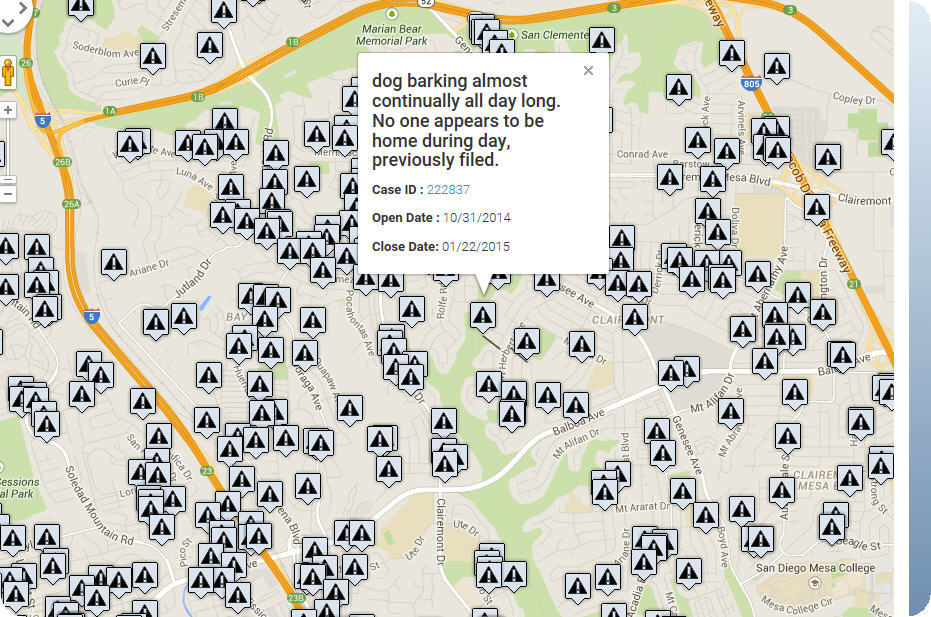
San Diego Potential Home Buyers – Map Lets You Know Problems In the Neighborhood Before You Buy

map of problems

website   http://www.sandiego.gov/development-services/opendsd/

Want to know if property prices are going up, down, stable?  Contact the appraisers at www.scappraisals.com

“The building is being used for Swinger parties with large amounts of people. Alcohol is also being brought in by the patrons and checked with a bartender.”

That unedited snippet, labeled as Case 221825, can be found online at what San Diego’s Development Services Department (DSD) calls OpenDSD. If you’re keen to go code-violation surfing, the city’s happy to be your enabler, with thousands of posted reports, complete with mapped street addresses that are usually accompanied by Google street-view photographs.

Not long ago, the folks downtown launched an online information portal that allows the public to “track the City’s land development permit processing functions.” Civic pride in evidence, the department boasts, “the scope of the data published exceeds that of any other city.”

Indeed, the city, while highlighting public access to prosaic fare such as permit applications and building inspections, goes on to note that “case activity is also provided.” Boy, is it ever. Jim Myers, deputy director at the Development Services Department says, “I don’t know of any other city that’s gone as far to make this information available to the public.”

You can find a lot of things online these days, including stuff that, in decades past, could only be obtained by combing through dusty folders or peering through microfiche viewers. If you want to stare down a cold-eyed con in safety or skulk around the neighborhood playing “Who’s the child molester?,” mug shots abound, courtesy of Megan’s Law. And if that’s not lurid enough, there’s always “The Faces of Meth,” exported from the redoubtable gendarmes of the Multnomah County Sheriff’s Department up in Oregon. But if you long to keep your voyeurism local, the OpenDSD database, which covers the entire city, allows you to cruise and peruse code-enforcement cases going back to 2011.

read more at: http://www.sandiegoreader.com/news/2015/mar/18/someone-is-living-container-cemetery/#

Disclaimer: for information and entertainment purposes only

Rooftop Solar Leases Scaring Buyers of Homes

Leased systems are considered personal property rather than part of a house. For many potential buyers, a solar lease is a liability rather than an asset, and may drive some people away.

Have questions about solar leases; contact the appraisers at www.scappraisals.com

Scott Vineberg, a SolarCity customer, received multiple offers for the Scottsdale, Arizona, home he sold in January. The lease made the deal more complicated because the buyers were reluctant to take over the contract and asked him to pay off the balance in advance, about 10 years of payments.

“I don’t think they understood it,” said Vineberg. He refused to pay off the lease, and instead provided years of documentation to verify the monthly energy savings. After the sale closed, the buyers opted to pay off the lease, and Vineberg installed another SolarCity system at his new home.

He had to “price the house lower than houses without solar to get people interested,” said Brian Neugebauer, the real estate agent at Re/Max Excalibur who helped sell the property. Potential buyers, he said, were “scared of the solar lease.”

There was one more hurdle: to take over the contract, SunPower had to approve the new leaseholder. The buyer’s credit score was a few points short of the solar company’s minimum, and was initially rejected. Bishopp had to persuade SunPower to reverse its decision.

Read entire article: http://www.bloomberg.com/news/articles/2014-06-23/rooftop-solar-leases-scaring-buyers-when-homeowners-sell

Disclaimer: for information and entertainment purposes only