
Is the Fed Blowing a New Housing Bubble?

Over the past year, the Federal Reserve has ramped up its policy of quantitative easing, with the result being new stock market highs and surging bond prices. Moreover, housing prices jumped 8%, the biggest annual gain since 2006.

The result is that more than a trillion dollars have been added to the market value of single-family homes. Homeowners are now wealthier and according to what economists call the “wealth effect,” they should be willing to spend more, helping the economy.

Live in San Diego?  Contact the appraisers at www.scappraisals.com for SD market questions.

But there is another, less sanguine view of the housing recovery. Recent data released by the Federal Housing Finance Agency (FHFA) suggest that the increase in house prices is not being driven by a broad-based improvement in the economy’s fundamentals. Instead, the Fed’s lower rates are simply being capitalized into higher home prices. This does not bode well for the future.

A comparison of FHFA’s conventional home-financing data for February 2012 and February 2013 shows that borrowers bought newly built and existing homes in 2013 for 9% and 15% more respectively than in the previous year. Increases of this magnitude cannot be attributed to higher incomes, as these rose a mere 2% over the last year, just keeping up with inflation. It appears that home prices are being levitated by quantitative easing. Because interest rates were .625% and .90% lower on new and existing homes respectively this year compared with last year, the monthly finance cost to purchase a new home remained the same and went up only 3% for an existing home.

While a housing recovery of sorts has developed, it is by no means a normal one. The government continues to go to extraordinary lengths to prop up sales by guaranteeing nearly 90% of new mortgage debt, financing half of all home purchase mortgages to buyers with zero equity at closing, driving mortgage interest rates to the lowest level in 100 years, and turning the Fed into the world’s largest buyer of new mortgage debt.

Read more at: http://www.aei.org/article/is-the-fed-blowing-a-new-housing-bubble/

Disclaimer: for information and entertainment purposes only

Cool Things: Zero Waste – This Family Generates Only 1 Quart of Trash a Year

waste

Bea Johnson sees through you. She sees through the hemp shopping tote where you slipped that plastic bag of fair-trade bananas, BPA/phthalate-free container of kombucha and organic Gorilla Munch that’s packaged in a bag inside a box. Johnson sees, as you get into your new electric Leaf, that you’re trying to live more sustainably but maybe you could use a little guidance. She’s just the one to offer it.

Will this lower your taxes since you are not using the city’s trash service?  Contact the appraisers at www.scappraisals.com for your property tax questions.


The Mill Valley resident, her husband, Scott, and their sons Max and Léo generate just one quart of trash a year. Johnson, who details her family’s efforts to live more sustainably in the popular blog www.zerowastehome.blogspot.com and recently released book of the same name ($17; Scribner) lives by the five R’s: refuse, reduce, reuse, recycle and rot – in that order. “Don’t take what you don’t need, even if it’s free,” she told Chronicle contributor Anh-Minh Le.


To learn more about how she and her family cut their consumption and reduced spending by 40 percent, go to bit.ly/11tqsCw. For a taste of the Zero Waste lifestyle, check out Johnson’s quick and easy tips. (Oh, and Johnson also sees you rolling your eyes at No. 6: “This is what I do,” she told The Chronicle. “If it works for you, too, great. If not, that’s fine. Figure out a system that works for you.”)


Simple ways to go trash-free


Bea Johnson’s recently released book, “Zero Waste Home” ($17; Scribner), shares her experiences, as well as the expertise she has developed in attempting to create a trash-free household. Here are some simple yet effective ideas she and her family have implemented:


1. Shop in bulk and bring cloth bags, mesh bags, glass jars and bottles to the store. They can hold different types of foods – such as grains, fruit, meat and olive oil. Bring totes, too, to carry all of your groceries home in.


2. Many beauty and bath products, including liquid soap and lotions, can also be purchased without packaging and some can be homemade. In Johnson’s case, she makes her own tooth powder (instead of toothpaste) and bronzer; the recipes are included in her book.


3. When it comes to housekeeping, again, Johnson goes the homemade route. She uses a vinegar mixture in lieu of a range of other cleaning products.


4. In the kitchen, she reduces food waste by employing various tricks, including freezing

Read more: http://www.sfgate.com/homeandgarden/article/Zero-Waste-How-green-can-you-go-4453596.php#ixzz2RIwI4CGb

Disclaimer: for information and entertainment purposes only
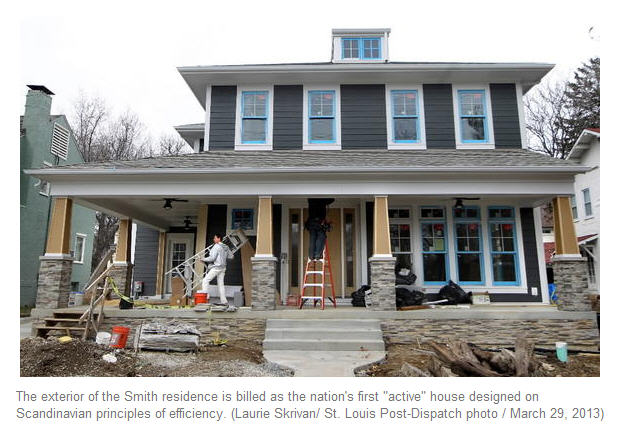
Property Spotlight – ‘Active’ House Blends Old and New Style Engery Efficiency

active

David and Thuy Smith’s new house at 215 Gray Avenue blends well with its neighbors, some more than a century old.

From its clapboard siding and stone-trimmed foundation to its wraparound porch with tapered Craftsman-style columns, the Smiths’ house appears at home, so to speak.

Is there value to making your home energy-efficient?  Contact the appraisers at www.scappraisals.com for your value questions.

But behind the old-time appearance is the latest in residential energy efficiency and low maintenance. Going green was the Smiths’ goal when they decided in 2011 to leave their 1940s bungalow in Brentwood.

What they are getting in Webster Groves is the first “active” house in North America, according to those involved in the project as well as specialty trade magazines.

“Active” construction combines energy efficiency, healthy indoor air and designs that take advantage of sun, shade and breezes. To compare, “active” house techniques are similar to those in LEED houses in the United States.

An open house is scheduled for today to give builders, real estate brokers and mortgage lenders a chance to inspect the Smiths’ innovative house. A public open house is set for Saturday.

The Smiths and their daughter, Cameron, 6, plan to move in next month.

In his design for the house, architect Jeff Day of St. Louis included numerous skylights to brighten the interior and, when open, to provide ventilation. The broad porch — something common before air-conditioning — shades first-floor rooms and protects part of the home’s fiber cement siding.

Read more at: http://www.chicagotribune.com/classified/realestate/home/sns-mct-active-house-blends-old–and-new-style-energy-20130308,0,7759441.story