
Tag Archives: value

Why Was the Appraisal Way Off the Zillows Price?

For millions of serious and not-so-serious homebuyers, the first stops in the house hunt are likely the Zillows and Trulias. Consumers are drawn to their simple and intuitive designs, and more importantly, the landslide of listing information they can gather after a few searches.

Have questions regarding the value of your home?  Contact the appraisers at www.scappraisals.com for your value questions.

What consumers can’t see is how the information is collected, culled and presented — a proprietary process that could lead to inaccuracies. Real estate agents and brokers in San Diego County and beyond have their horror stories: incorrect bed and bath counts, duplicates with differing prices and homes listed as active when they have already sold. What’s the likely implication of this for consumers? Misinformed buying decisions.

It’s also important to note that the Zillows and Trulias also draw from various sources. They include data providers, brokerages, individual agents and MLSs.

So the results you see on those sites represent a lot of data changing hands and being cleaned up in ways that are not disclosed to the public.

Read more at: http://www.utsandiego.com/news/2012/mar/10/do-real-estate-search-sites-miss-accuracy-mark/

Disclaimer: for information and entertainment purposes only
Protecting Against Structural Calamities

structure

New homes may be new, but they are rarely perfect.

Houses are giant puzzles with hundreds of parts, all manufactured at different locations and carried to the building site. And try as they might to put together a flawless product, builders and their numerous subcontractors don’t always get things right.

Luckily, buyers are more likely to have to deal with cosmetic defects than out-and-out structural failures. Scratched refrigerators, broken bathroom tiles and faulty electrical outlets are far more prevalent than badly cracked foundations or sagging roofs.

Is there value in a home with a cracked foundation or structural issues?  Contact the appraisers at www.scappraisals.com for your value questions.

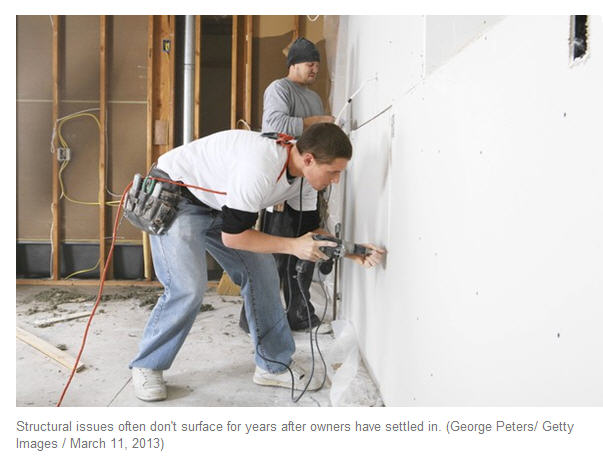
But structural defects do occur. According to recently released data from 2-10 Home Buyers Warranty, owners of new homes are as likely to experience major structural damage — big cracks in the walls, windows and doors jammed shut, buckled floors — as they are a major fire.

This isn’t to warn buyers off new construction. Previous research has found that just one in 20 houses will experience a major structural hit over its lifetime. But one in every four will experience “some” structural distress.

Based on his review of more than 10,000 structural claims over a 32-year period, Walt Keaveny, chief risk manager of the Denver-based warranty company, says structural problems can occur from day one. But most claims are reported between four and seven years after initial occupancy.

Read more at: http://www.chicagotribune.com/classified/realestate/home/sc-cons-0314-home-structural-defects-20130315,0,2388781.story

Equity Credit Lines and Second Mortgages are Making a Comeback

WASHINGTON — Using your home as an ATM no longer is a financial option, but the tools that allowed owners to pull out massive amounts of money during the boom years — equity credit lines and second mortgages — are making a comeback.

Want to take that money and add value to your home?  Contact the appraisers at www.scappraisals.com for your value questions.

Banking and credit analysts say the dollar volumes of new originations of home equity loans are rising again, significantly so in areas of the country that are experiencing post-recession rebounds in property values. These include California, Arizona, New Mexico, most of the Atlantic coastal states, the Pacific Northwest, Texas and parts of the Midwest.

Not only have owners’ equity positions grown substantially on a national basis since 2011 — up an estimated $1.7 trillion during the last 18 months, according to the Federal Reserve — but banks increasingly are willing to allow owners to tap that equity. Unlike during the credit bubble years of 2003-06, however, they aren’t permitting owners to go whole hog: mortgaging their homes up to 100% of market value with first, second and even third loans or credit lines.

Now major lenders are restricting the combined total of first and second loans against a house to no more than 85% of value. For instance, if your house is worth $500,000 and the balance on your first mortgage is $375,000, you’d probably be limited to a second mortgage or credit line of $50,000.

Contrast this with 2007, the high-point year of home-equity lending, when many lenders offered “piggyback” financing packages that allowed 100% debt without private mortgage insurance. A buyer of a $500,000 house could get a $400,000 first mortgage and a second loan of $100,000.

That ultimately didn’t work well for the banks. During the third quarter of 2012 alone, according to federal estimates, banks wrote off $4.5 billion in defaulted equity loans, often in situations in which homeowners found themselves underwater and behind on both first and second loans.

In such a situation, second mortgages become essentially worthless to the bank since in a foreclosure, the holder of the first mortgage gets paid off first. On underwater foreclosures, the second loan holder is left holding the bag.

Read more at: http://articles.latimes.com/2013/apr/19/business/la-fi-harney-20130421

Disclaimer: for information and entertainment purposes only